
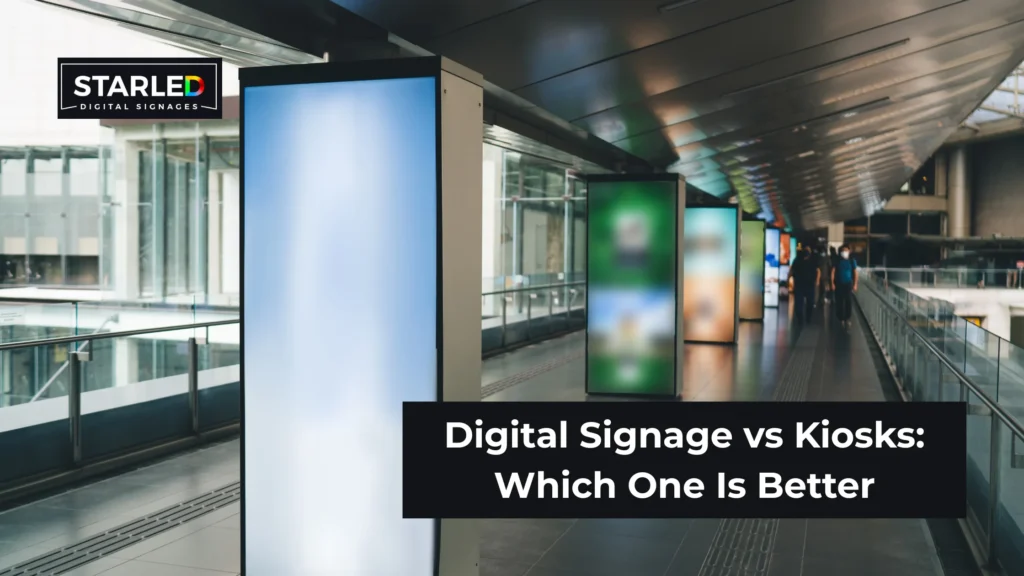
Walk into any mall, airport or government centre in the UAE and you will see two kinds of screens. One hangs on a wall playing ads and announcements to everyone who passes. The other is a freestanding unit with a touch screen that lets you tap, search and get something done.
Both look similar from a distance. But they solve completely different problems.
Digital signage broadcasts content to many people at once and needs no interaction. A kiosk serves one person at a time and lets them complete a task like check-in, ordering or payment. A digital signage kiosk combines both, a freestanding display that shows content and can add a touch layer when needed. If your goal is visibility, choose signage. If your goal is self service, choose a kiosk.
Now let me break down how that plays out in real spaces, what each option costs, and how to pick the right one for your business.
What Is Digital Signage?
Digital signage is any electronic display that shows multimedia content to a broad audience. That covers wall-mounted screens in shops and offices, LED video walls in malls and lobbies, and large LED billboards on building facades.
These screens run videos, promotions, menus, wayfinding and live data on a loop. The goal is one-to-many communication. One screen reaches hundreds or even thousands of people a day without anyone touching it.
Modern setups in the UAE typically use high-brightness indoor LED displays for retail and corporate spaces, and public or outdoor sites use weather-rated LED walls built to stay sharp in bright sunlight.
What Is an Interactive Kiosk?
An interactive kiosk is a self-contained terminal that does more than show content. It combines a touchscreen, software and often extra hardware like a printer, scanner or card reader.
You have already used one this week. Airport check-in machines, mall directories, self-order screens at restaurants and payment terminals at government centres are all kiosks. People walk up, complete a task and walk away.
The core difference is simple. Digital signage talks. A kiosk listens and responds.
What Is a Digital Signage Kiosk?
This is the term that confuses most buyers, and it also happens to be what most people search for. A digital signage kiosk is a freestanding display unit, usually a slim totem or poster-style LED screen, that stands on its own instead of mounting to a wall.
Think of it as signage that moved into the middle of the room. It puts your content at eye level in walkways, entrances and queues where wall space does not exist. Some models are display-only, while others add a touch layer so the same unit can switch between advertising and self service.
Digital signage kiosks come in a few common forms:
- Floor-standing totems: slim vertical displays for lobbies, malls and showrooms, usually 43 to 75 inches
- Poster LED displays: ultra-thin plug-and-play Poster LED screens that set up in minutes and can move between locations
- Countertop units: compact 10 to 22 inch screens for reception desks and checkout counters
- Outdoor totems: weather-sealed, high-brightness units built for direct sun, heat and dust
So when a supplier in Dubai says digital signage kiosk solutions, they usually mean these self-contained display units, not full transaction kiosks. Knowing the difference protects your budget before you request a single quote.
Digital Signage vs Kiosk: Quick Comparison
| Digital Signage | Interactive Kiosk | Digital Signage Kiosk | |
| Main job | Inform and promote | Complete a task | Display, with optional touch |
| Interaction | Passive | Fully interactive | Display-only or simple touch |
| Audience | Many at once | One at a time | Many, or one if touch-enabled |
| Typical hardware | Screen plus media player | Touchscreen, printer, card reader | Screen in a freestanding case |
| Best for | Awareness, branding, menus | Ordering, check-in, payments | Entrances, walkways, quick info |
| Relative cost | Lower | Higher | Low to medium |
| Upkeep | Low | Higher, more parts | Low |
The Key Differences That Actually Matter
Both are screens, but three factors decide which one fits your space.
Interactivity. Digital signage is passive and plays content to inform or promote, and one screen can reach many people fast. A kiosk is interactive by design, so people tap, scroll and enter data, and the system responds to each choice.
Purpose. Signage is built for broadcast and branding, things like promotions, welcome messages, schedules, live information and menus. Kiosks are built for self-service tasks like product lookups, ordering, wayfinding, ticketing, bill payment and document submission.
Reach. Signage reaches everyone who can see the screen, so one unit in a busy area serves hundreds. A kiosk works one person at a time, and each session is deeper and more personal.
That is why the question is never which technology is better. It is which job needs doing first.
What Do Digital Signage and Kiosks Cost?
Here is where the two options really separate. Digital signage is generally the lower-cost option because it is a screen and a player with few moving parts.
A commercial wall-mounted display setup in the UAE typically starts from around AED 2,500 to AED 8,000 per screen depending on size and brightness, and a small LED poster display or lobby screen with a building-facade LED wall sits at the premium end. Interactive kiosks cost more, usually AED 8,000 to AED 40,000 or beyond, because you are paying for the touchscreen, the enclosure, the software and any extras like printers or payment modules.
The cheapest sensible starting point for most businesses is a single freestanding poster LED or wall-mounted display. Printed posters look cheaper on day one, but reprinting for every campaign adds up, and you lose the ability to change content in minutes.
Indoor vs Outdoor Digital Kiosk Cost Comparison
Outdoor units are not just indoor units placed outside. They need sealed enclosures, cooling, and 2,000 nits or more of brightness to stay readable in UAE sun, which is why the price roughly doubles.
| Factor | Indoor Kiosk | Outdoor Kiosk |
| Typical hardware cost | AED 6,000 to 35,000 | AED 18,000 to 75,000+ |
| Screen brightness | 350 to 500 nits | 1,500 to 2,500+ nits |
| Enclosure | Standard steel or aluminium | IP65 sealed, heat managed |
| Installation | 2 to 4 hours | 1 to 2 days, may need civil work |
| Best placement | Lobbies, malls, showrooms | Facades, plazas, drive-throughs |
These are indicative UAE market ranges. Final pricing depends on screen size, pixel pitch for LED units, touch capability and installation conditions, so treat these as planning numbers rather than quotes.
Static vs Digital Kiosk Cost
A static kiosk or printed pylon costs less upfront. But every content change means new printing, new installation and days of waiting.
A digital kiosk costs more on day one and then almost nothing per update. If your content changes weekly or even monthly, digital usually pays for itself within the first year or two of campaigns.
Do They Increase Sales and Cut Queues?
Used well, yes. But the gain comes from placement and content, not the hardware alone.
Digital signage lifts sales when it sits where people already look and shows the right message at the right time. Motion and fresh content hold attention far better than a static poster, which is why screen-led menus and offer walls consistently outperform print in busy counter areas.
Kiosks reduce wait times by taking routine tasks off your staff, so queues move faster and your team handles the cases that need a human. One honest caveat here. A kiosk only delivers if the interface is clear, because a confusing or slow flow gets ignored and people return to the counter.
Reliability, Lifespan and Upkeep
A commercial LED display typically runs for tens of thousands of hours and needs little more than occasional cleaning and a content refresh. Fewer parts means fewer failures.
A kiosk has more to maintain, the touchscreen, the printer, the card reader. When one unit goes offline, that self-service point is gone until it is fixed, so plan for spares and support. For both, keep the build commercial grade. A consumer screen or an old PC running as a media player tends to overheat, stutter or fail in continuous use.
Will It Survive UAE Sun and Heat?
For indoor screens facing a window, the answer is usually about brightness. A standard indoor screen washes out behind glass in summer, so choose a high-brightness panel for sun-facing positions.
For true outdoor deployment in Dubai, Abu Dhabi or anywhere in the Gulf, only weather-rated outdoor LED hardware makes sense. That means sealed enclosures rated for dust and humidity, active heat management, and brightness levels built for direct sunlight. This is the single most common mistake we see in outdoor projects, and it is the most expensive one to fix after installation.
Managing Content Across Multiple Screens
Modern signage runs from a central content management system, so you update one screen or a hundred from a single place. You can swap creatives for a new campaign, schedule content by time of day, and localise messages by branch.
That flexibility is the main reason digital beats print for any business that changes its message often. A networked estate of screens or kiosks takes longer to set up than a single unit, but the day-to-day management is genuinely straightforward once it is live.
How UAE Industries Use Both Together
The strongest deployments we see pair signage and kiosks side by side.
Retail and malls run signage for campaigns and ambience, with kiosks for wayfinding and store directories. Hospitality uses lobby and event signage, with kiosks for self check-in. Healthcare runs signage for queue status and health guidance in waiting areas, and kiosks for patient check-in and bill payment so front desks are less crowded.
Transport and government follow the same split. Signage informs and guides at scale, while kiosks handle the action, ticketing, payments and registration. The pattern is consistent across every sector. Signage pulls attention, and the kiosk closes the task.
So, Which One Should You Choose?
Start with three questions. Do you mainly need to show information to many people, or help individuals finish a task? Are visitors passing through and glancing, or arriving with a specific job to do? Do you need broad coverage across a site, or a few high-impact self-service points?
If your priority is awareness and promotion at scale, digital signage is the better first investment, and a freestanding poster LED or wall display is the easiest entry point. If your priority is cutting queues and automating routine jobs, an interactive kiosk should top the list.
For most busy UAE spaces, the right answer is a measured mix of both. Signage draws the eye. The kiosk finishes the job.
Plan It for Your Space
StarLED Display is a Dubai-based LED display manufacturer. We design and supply the display side of both worlds, from signage screens and LED walls to freestanding digital standees for your plug-and-play self-service front end.
See finished work on our LED Display Projects, browse the full LED display range, or book a free site survey. We will recommend the right screens for your goals and your footfall. Call +971 56 811 2211 or contact our team.
Frequently Asked Questions
What is a digital signage kiosk? A digital signage kiosk is a freestanding or wall-mounted display unit in a finished enclosure, built to show digital content out of the box. Some are display-only for menus and offers, while others add a simple touch layer for directories or lookups. It is not the same as a full self-service kiosk with printers and payment hardware.
What is a digital kiosk, in simple terms? A digital kiosk is any standalone screen unit placed in a public or commercial space to display information or let people interact with it. If it only shows content, it works as signage. If it takes input like taps, searches or payments, it works as an interactive kiosk.
What is the difference between digital signage and touchscreen kiosks? Digital signage is one-way and broadcasts to everyone nearby, while a touchscreen kiosk is two-way and serves one user at a time. Signage costs less because it needs no touch hardware or task software. Choose signage to inform at scale and a touchscreen kiosk to let customers complete tasks themselves.
How much does a digital signage kiosk cost in the UAE? Indoor display-only units typically start from around AED 6,000, touch-enabled indoor kiosks from around AED 8,000 to 40,000, and outdoor-rated units from roughly AED 18,000 upward. Screen size, brightness, touch capability and installation conditions move the final number, so a site survey gives the most accurate figure.
Can digital signage or kiosks work in direct sunlight in the UAE? Yes, but only with outdoor-grade hardware. You need a high-brightness weather-rated display, a sealed dust-resistant enclosure and proper heat management. A standard indoor screen will wash out and can fail within a summer here.
Do customers actually use self-service kiosks? They do, when the flow is clear and fast and the unit sits where people expect it. Adoption rises with bilingual English and Arabic interfaces. A confusing or slow interface is the main reason kiosks get ignored.
Can a tablet or an old computer instead of a kiosk? For very light, low-traffic use, a tablet can work as a stopgap. For commercial duty, bright spaces or all-day operation, consumer tablets and old PCs tend to overheat and fail, which costs more in downtime than a proper unit saves upfront.
How long does a commercial display or kiosk last? A commercial LED display typically runs for tens of thousands of hours with minimal upkeep. A kiosk’s screen lasts similarly, but its printers and readers are the parts that need servicing over time.
What happens if a power outage hits? Both restart automatically when power returns and resume their content, as long as a commercial-grade system with a proper media player or built-in scheduling is in place.
How often do I need to update content? As often as your message changes. The advantage of digital over print is that you update in minutes from one place, schedule by time of day, and run different content per location.
Can a kiosk replace customer service staff? It replaces routine, repetitive tasks, not people. Kiosks clear simple jobs like check-in and payment so your team can focus on the cases that need human help.