
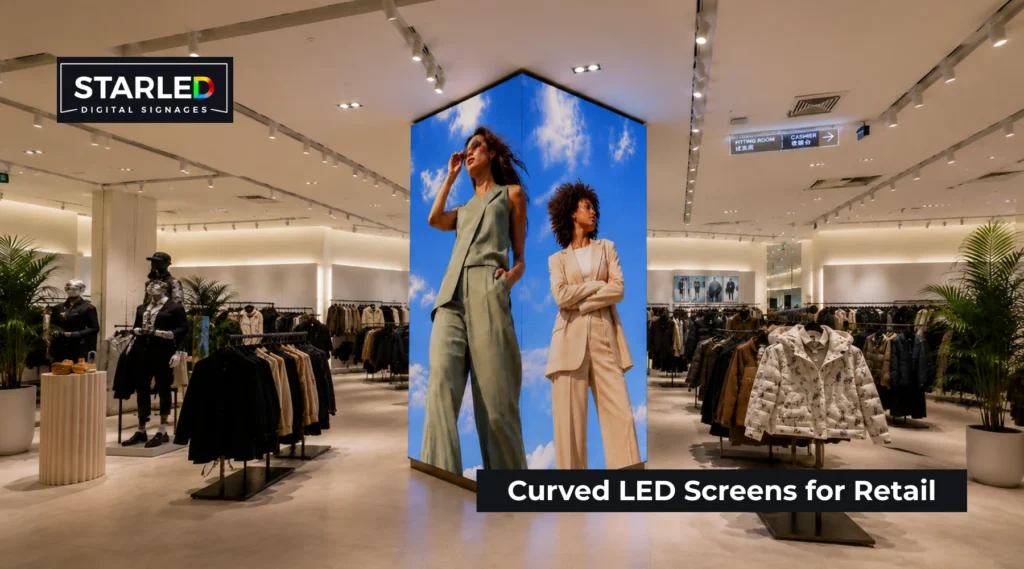
You are in a fit-out meeting with two quotes on the table. Same size, same pixel pitch, same brand. One is a flat wall. The other curves around the entrance, and it costs noticeably more. The designer loves the curve. The finance lead wants to know what the extra spend buys beyond a nicer photo.
That is the right question. A curve is not automatically better. It is better in specific situations and a waste of money in others. After years of building both across Dubai retail, here is how we tell the difference.
So, is a curved retail screen worth it?
A curved LED screen typically costs 10% to 25% more than an equivalent flat wall, and a full curve or column wrap can push higher. The premium is worth it when the screen has to wrap a column, turn a corner, or sit on a facade where flat physically cannot follow the architecture, or when immersion is the actual goal, such as a flagship feature wall that surrounds the shopper.
It is not worth it when you simply need a wall to show promotions and prices. Flat does that job for less, and it is easier to service. Pay for the curve when the shape does real work, not when it only looks good in a render.
Let me break down where the money goes, and how to judge which side of that line your project sits on.
Why a curve costs more
The premium is not a markup for fashion. It comes from real engineering.
A flat wall uses standard cabinets in a straight line. A curve needs either custom-angled cabinets or flexible modules, a purpose-built frame to hold the exact radius, and far more alignment and calibration time on site so the joints disappear. Install labour rises because every cabinet has to land at a precise angle, not just flush against a flat surface. Commissioning a curve takes longer than a flat wall of the same size.
Once you understand that, you can read a quote properly. A fair curved price reflects custom structure and extra labour. A price that is double the flat equivalent usually means a tight radius, a flexible build, or a complex 3D shape, and you should ask the vendor to confirm which.
The two ways to build a curve, and what each suits
This is the part most retail buyers never get explained, and it decides everything about cost and result.
Faceted curve-lock cabinets. Standard rigid cabinets connect at small fixed angles, often 2.5, 5, or 10 degrees, so the wall steps gently into a curve that reads as smooth from normal viewing distance. These are rugged, cost-effective, and the sensible choice for gentle, large-radius curves: broad feature walls, lobby arcs, wide facades. The trade-off is the minimum radius. A typical cabinet reaches down to around a 5 to 7 metre radius, so it cannot do tight bends.
Flexible modules. These are built on soft, bendable backing instead of a rigid frame, so they form true smooth curves and can bend outward. They wrap columns, create convex and cylindrical shapes, and can curve to a radius as tight as half a metre. The trade-offs are real: they cost more per square metre, they need a custom steel frame because they do not support themselves, they usually run at lower brightness (around 800 to 1,200 nits), and they are indoor products. They are also more delicate to handle.
The deciding factor is your curve radius. Gentle and wide, use faceted cabinets and save money. Tight, convex, or wrapping a pillar, you need flexible modules, and the higher price is not optional.
Where a curve earns its money in retail
A curve pays back when the shape captures attention that a flat screen would miss.
A column wrap is the clearest case. Shoppers approach a pillar from every direction, and a cylindrical screen is readable from all of them. A flat screen on a column wastes most of its audience.
A storefront corner is the second. A screen that turns the corner catches foot traffic coming from two streets or two mall walkways at once, instead of facing one way and missing the rest. For a corner, a curve or a seamless 90-degree corner cabinet often captures far more eyes per day than a flat panel on a single face.
A flagship feature wall is the third. When the goal is to wrap the customer in the brand and hold them longer, a concave curve that bends the image toward the viewer does something flat cannot. Longer dwell time and stronger brand recall are the return here, which matters most for premium and experiential retail.
In each case the curve is doing commercial work: reaching more people, or holding them longer. That is what justifies the spend.
When flat is the smarter spend
Honesty sells better than a curve you will regret.
If the screen sits flat against one wall and shows promotions, menus, or pricing, buy flat. It is cheaper, brighter for the money, and any module is faster to swap when something fails.
If you only need to turn a corner, a 90-degree corner cabinet is usually cheaper and more rugged than a full curve, and it gives you a clean corner with no visible seam.
If the goal is a storefront window that customers can still see through, a transparent LED display fits the brief better than a curve.
And if you want flexibility to move the display or run simple content, a freestanding poster or standee beats a fixed curved wall on cost and effort.
The five questions that decide if a curved screen works
Before you sign, get clear answers to these.
- Radius versus build. Is your curve gentle enough for faceted cabinets, or tight enough to need flexible modules? This sets the price and the supplier.
- Pixel pitch versus viewing distance. A curve does not change this rule. Match the pitch to how close shoppers stand, or you pay for resolution nobody sees, or buy a screen that looks coarse up close.
- Concave or convex. Convex and column wraps generally need flexible modules. Confirm the build can actually bend the way your design demands.
- Maintenance access. On a curved or column screen, can a faulty module be reached and replaced from the front, or does the structure block rear access? Get this answered before install, not after the first fault.
- Who builds the frame. A curve is only as accurate as the structure behind it. Confirm who engineers and builds the frame to the exact radius, and that they will calibrate the joints so the curve looks seamless.
A supplier who answers these crisply is one who has built curves before. Vague answers are a warning.
Quick verdict
Worth the extra cost if: the screen wraps a column or corner, sits on a facade, or its job is to immerse and hold the shopper in a flagship space.
Skip it if: the screen is a flat feature wall for promotions, the budget is tight, or you mainly need fast, simple servicing.
How we approach curved retail in Dubai
We build both types, so the recommendation follows the project rather than a single product.
For high-touch flagship interiors, we use fine-pitch COB indoor displays at P0.9 to P1.8, with a sealed IP65 wipe-clean surface and a 100,000-hour rating, which holds up to crowds and cleaning far better than open-surface panels. For broad indoor feature walls we use faceted curve-lock cabinets to keep the cost sensible. For storefront corners and facades we use the XAO Series curved and 90-degree corner cabinets, which connect seamlessly with standard cabinets and carry full outdoor protection.
Our Dubai team handles the structure, the install, and the calibration in-house, and we work directly with your architect or fit-out contractor to lock the exact geometry before anything is fabricated. Getting the configuration right the first time is the real saving. A curve specified wrong is an expensive thing to rebuild.
See finished work on our Projects page and retail examples in our Retail and Malls case studies, or browse the fullIndoor Displays range.
For a straight answer on whether your space justifies a curve, book a free site survey. We will assess the geometry, viewing distances and footfall, then tell you honestly whether curved or flat is the better spend. Call +971 56 811 2211 or contact our team.
Frequently Asked Questions
How much more does a curved LED screen cost than a flat one?
A curved LED screen usually costs 10% to 25% more than an equivalent flat wall of the same size and pixel pitch. The extra goes on custom-angled or flexible cabinets, a purpose-built frame to hold the radius, and longer install and calibration time. A tight curve, a column wrap, or a full 3D shape pushes the figure higher, and complex creative shapes can approach double.
Are curved LED screens worth it for retail?
They are worth it when the shape does real work: wrapping a column, turning a storefront corner, following a facade, or immersing the shopper in a flagship feature wall. In those cases a curve reaches more people or holds them longer than flat can. For a plain wall showing promotions or pricing, flat is the smarter spend, since it is cheaper, brighter for the money, and faster to service.
How is a curved LED screen actually made?
There are two methods. Faceted curve-lock cabinets are rigid panels connected at small fixed angles, which form a smooth-looking curve for gentle, large-radius shapes. Flexible modules use a bendable backing that forms true tight curves and can wrap outward around columns. The LEDs themselves are not bent; the curve comes from the cabinets and the frame behind them.
How tight can a curved LED screen bend?
A faceted curve-lock cabinet typically reaches a minimum radius of around 5 to 7 metres, which suits broad feature walls and lobby arcs. For anything tighter, such as wrapping a standard column, you need flexible modules, which can curve to a radius as small as about half a metre. Convex and cylindrical shapes also require flexible modules, because rigid cabinets cannot bend outward.
Do curved LED screens cost more to maintain?
They can, mainly because reaching a faulty module on a curve or a column is harder than on a flat wall. The fix is to confirm front-access servicing before install, so a module can be swapped without dismantling the structure. For high-touch retail interiors, a sealed COB display with a wipe-clean surface also reduces day-to-day upkeep.
Can a curved LED screen be installed outdoors in Dubai’s climate?
Yes. Curved and 90-degree corner cabinets from the XAO Series carry full IP68 outdoor protection and run at up to 10,000 nits, so they hold up to direct sun, dust and humidity on a storefront or facade. Flexible-module curves, by contrast, are indoor products and should not be used on an exposed exterior.
What pixel pitch do I need for a curved retail screen?
The same rule applies as for flat: match the pixel pitch to how close shoppers stand. A close-viewed interior screen needs a fine pitch such as P0.9 to P1.8, while a screen viewed from across a concourse can use a wider pitch. A curve does not change this, so do not pay for resolution nobody will see, or buy a pitch that looks coarse up close.