
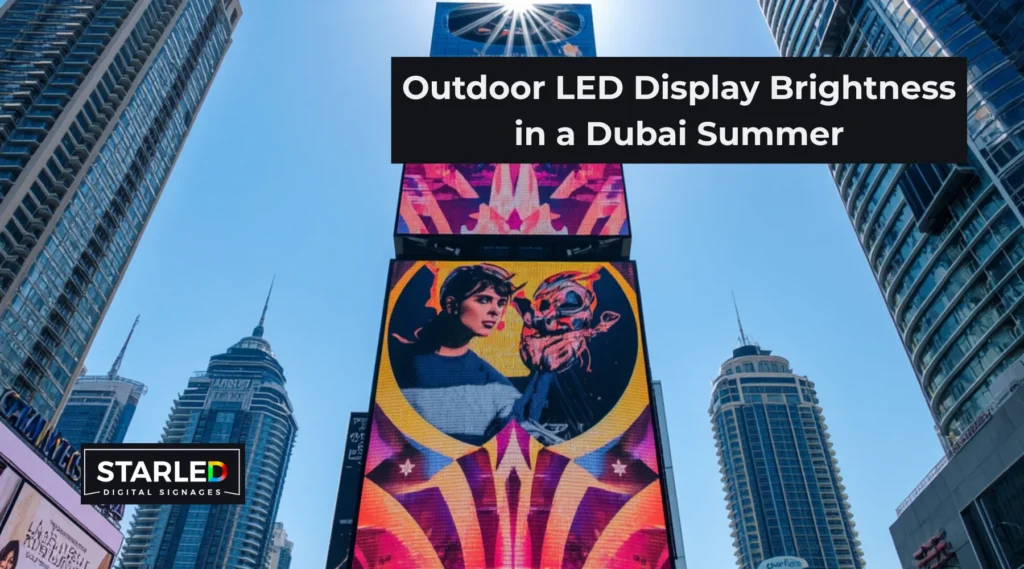
It is 2pm in late July on Sheikh Zayed Road. The billboard that looked sharp in the supplier’s air-conditioned showroom is now washed out, and the whites have drifted to a faint cyan. By August the colour shift is permanent. That screen did not fail because the brand was cheap. It failed because it was specified for a climate it was never going to face.
If you manage outdoor screens here, brightness is not a marketing number. It is the line between a display that earns its slot and one that becomes a warranty claim. So let me answer the question most clients open with.
How many nits does an outdoor LED billboard need in direct Dubai sunlight?
For a billboard in direct sun, you need 8,000 to 10,000 nits. For a screen that sits in shade or under a canopy, around 5,000 nits is enough. Anything below 5,000 nits will struggle the moment the sun is high.
The reason is simple. Brightness has to beat the ambient light hitting the screen, not the light in the room where you signed the contract. Direct Dubai sun pushes past 100,000 lux. A 5,000-nit panel that looks brilliant indoors disappears against that sky. This is why the same model that performs in Europe underperforms here.
But nits are only half the story. The harder problem is keeping those nits alive through the summer.
What 48°C ambient actually does to a panel
DEWA’s regulations for electrical installations set Dubai’s maximum outdoor shade ambient at 48°C, with sandstorms and heavy condensation noted as standard conditions. For equipment design, the city treats 50°C as the ceiling. That is the shade figure. A black LED cabinet bolted to a south-facing facade, absorbing sun all afternoon, runs far hotter on its surface and hotter still inside.
That internal heat is what kills cheap panels. Here is the chain of damage every facilities manager should understand.
An LED converts most of its wasted energy into heat at the chip. Inside the package, the phosphor layer runs 30°C to 50°C hotter than the chip junction. As those temperatures climb, the encapsulant yellows, the phosphor degrades, and the red, green and blue elements age at different rates. That uneven ageing is the colour shift you see on tired screens, often a green or cyan cast as the red output fades first. Brightness drops permanently too. A reliable rule of thumb: every 10°C rise in junction temperature can roughly halve an LED’s useful life.
Once a budget panel’s internal temperature sits above about 60°C for hours at a stretch, you are no longer losing performance slowly. You are watching it leave. This is the failure pattern behind almost every “the screen looks faded” call we take after a Dubai summer.
So the real specification question is not only “how bright,” but “how does it stay bright at 60°C.”
Why passive ventilation fails here, and what replaces it
There are three ways to deal with the heat inside an outdoor cabinet.
Passive ventilation uses vents and openings so air can move through the cabinet. It works in mild climates. It fails in Dubai for two reasons. First, the air you are pulling in is already 45°C and loaded with fine dust, so it cools almost nothing and clogs everything. Second, every vent is a hole, and holes destroy your sealing against sand and humidity. You cannot have an open cabinet and a dust-proof one at the same time.
Active cooling adds powered components such as fans or, in some designs, small cooling units behind a sealed wall. It moves more heat, but every fan is a moving part that draws power, collects dust, and eventually fails in the field.
Engineered conduction cooling seals the cabinet completely and turns the body itself into the heatsink. A high-conductivity metal chassis pulls heat away from the LEDs and sheds it across a large finned surface. No intake air, no clogging, fewer moving parts to fail. For sustained high-brightness outdoor use in this climate, a well-designed sealed conduction system is usually more reliable than fans.
The takeaway for your spec sheet: do not accept “it has ventilation.” Ask how the screen rejects heat while staying sealed.
IP ratings: your defence against dust and sandstorms
You will see screens advertised as IP65 with “active cooling.” It is worth knowing exactly what the rating means, because it is defined by a real standard (IEC 60529), not by the brochure.
The first digit covers solids. A 6 means fully dust-tight, which is what matters most against UAE sand. The second digit covers water. IP65 means dust-tight plus protection from low-pressure water jets. IP68 means dust-tight plus protection against continuous submersion. For a coastal, dusty, humid environment, the higher the second digit, the more margin you have against driven rain, wash-downs and condensation.
The trap is the combination. A panel cannot be genuinely sealed to IP68 and rely on open passive vents at the same time. If a vendor claims both, ask them to explain the contradiction.
Auto-dimming: a setting, or a crutch?
Auto-dimming is fine when it is a choice. Stepping brightness down at night for legibility and energy saving is good practice. We do it on our own installs.
Auto-dimming becomes a problem when the screen uses it to protect itself from overheating. If a panel quietly throttles its own brightness at 2pm because it cannot handle the heat, you are not getting the 10,000 nits you paid for. You are getting whatever the thermal design can survive. That is a hardware limitation dressed up as a feature, and it shows up as a dim, uneven picture during the exact hours your advertising is most valuable.
When you validate a screen, check that it holds rated brightness through the hottest part of the day, not just at the moment of switch-on.
How to prove a screen will survive before you buy
Brightness on a datasheet is a claim. Survival is a test. The international benchmark is the IEC 60068-2 series, and a serious outdoor product will have been run against the relevant parts:
- IEC 60068-2-2 (dry heat) for sustained high-temperature endurance.
- IEC 60068-2-78 (damp heat, steady state) for coastal humidity.
- IEC 60068-2-68 (dust and sand) for sandstorm exposure.
- IEC 60068-2-14 (change of temperature) for the day-to-night thermal cycling that fatigues seals and solder joints.
Ask any vendor which of these tests their cabinet has passed, and at what severity. The answer tells you more than any brightness figure.
Your heat-season maintenance checklist
Even a well-built screen needs care before and through summer. Run this from May onward:
- Inspect gaskets and cable glands for UV cracking and dust ingress; reseal where needed.
- Thermal-scan the cabinet face and rear at midday and log any hotspots against last year’s baseline.
- Confirm the screen holds its rated brightness between 2pm and 4pm, with no self-throttling.
- Check colour calibration against your reference; catch early drift before it becomes permanent.
- Compare power draw to spec. A steady climb often signals a component starting to fail.
- Keep spare modules and power supplies in-country so a fault is a same-week swap, not a six-week import wait.
Where the XAO Series fits
We built the XAO Series (Black Rhino) for exactly this brief: full brightness at 45°C-plus, with no throttling and no colour collapse.
It runs at 8,000 nits, with a 10,000-nit option for direct sun, and carries an IP68 sealed rating against dust, sand and humidity. Its operating range is −20°C to 60°C, so it is specified to the top of Dubai’s real conditions, not just its averages. Cooling is handled by a sealed, die-cast magnesium-aluminium body with 230 W/mK thermal conductivity, which keeps the driver ICs running around 10°C cooler than conventional panels at the same brightness. There are no open vents to clog.
The performance gap shows up in our controlled P8 testing. Against a same-tier conventional panel at 8,000 nits, the XAO held its colour with no shift while the conventional unit drifted to a cyan tint, and it showed roughly 5% brightness decay against the conventional panel’s 12%. It also pulled 550 W/m² versus 720 W/m², about 25% less energy. On a screen running 18 hours a day, that is a real cut to your running cost, year after year.
That is the OPEX argument in one line: a panel that holds its brightness and colour does not need early replacement, does not throttle through your prime advertising hours, and costs less to power every day it is switched on.
Specify it once, properly
A cheap outdoor screen is only cheap until the first July. The right specification is straightforward: 8,000 to 10,000 nits for sun, a sealed IP68 build, conduction-led cooling rated to 60°C, and proof of IEC 60068 testing.
We supply, install and service outdoor screens across Dubai, Abu Dhabi and the wider GCC, with stock held locally and a five-year warranty backed by a Dubai-based team. See live results on our Projects page, compare options across the Outdoor Displays range, or book a free site survey and we will assess your viewing distances, solar exposure and structural loading, then hand you a written spec.
Call +971 56 811 2211 or contact our team to start an RFQ.