
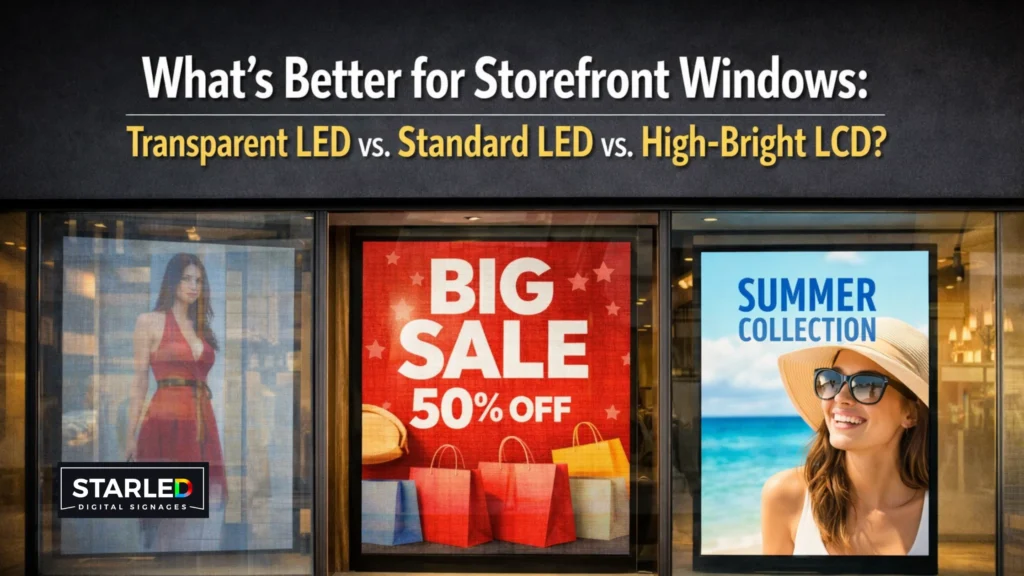
In a city where the sun shines brighter than shop signs, your storefront window display is your first handshake with a customer. In Dubai’s malls and streets the average passerby gives you seconds before moving on, so your message must cut through glare, dust and distraction. The right display technology, transparent LED, standard LED or high‑brightness LCD makes the difference between a store that blends in and one that stops traffic. This guide compares these options using 2026 benchmarks, local UAE insight and technical data so you can choose with confidence.
What is a transparent LED screen?
Transparent LED screens are modular panels made with discreet LED strips that allow light to pass through. They deliver 60‑90 % transparency and create the illusion of content floating in front of your products. Because the LED clusters are spaced apart, these screens are lightweight, often 3-10 kg per m² and consume less energy. However, their open structure means they cannot match the brightness or contrast of opaque LED walls, making them less effective against strong sunlight.
Read our blog on- Transparent LED Displays
What is a standard (traditional) LED screen?
Standard LED screens are solid, opaque modules densely packed with LEDs. They deliver high brightness (800–6 000 nits or more), making them readable through glass and direct sunlight. Their rigid construction also allows for custom sizes and seamless video walls. The trade‑offs? These displays are heavy (tens of kilograms per square metre) and require significant power and structural support. They block the view behind them and consume more energy because the LEDs are tightly packed.
What is a high‑brightness LCD?
High‑brightness LCDs are commercial‑grade monitors tuned for window applications. They use advanced backlights to achieve up to 3 000 nits, roughly ten times brighter than regular indoor LCDs. They retain the slim form factor and high resolution of traditional LCDs and often include auto‑brightness sensors and high‑temperature panels. Unlike LED screens, LCD panels come in fixed sizes (32″–86″ are typical) and cannot scale seamlessly into large walls. Their brightness, while impressive, still falls below that of outdoor‑grade LEDs; midday desert sun may still wash them out if positioned behind glass.
Comparison: Transparent LED vs. Standard LED vs. High‑Bright LCD
| Feature | Transparent LED | Standard LED | High‑Bright LCD |
| Typical brightness (nits) | 1 000–3 000 (lower due to gaps) | 800–6 000+; outdoor versions reach 10 000 | ~2 000–3 000 |
| Transparency | 60–90 % | 0 % (opaque) | 0 % |
| Weight / design | 3–10 kg/m²; slim | Heavy; requires robust support | Slim monitor-like form factor |
| Energy use | Low due to fewer LEDs | Higher (brighter = more power) | Moderate; bright backlights increase consumption |
| Cost | Highest per square metre | Moderate (varies by pixel pitch and size) | Lower per unit; but limited to fixed sizes |
| Maintenance | Modular; specialised installation; harder access | Modular; easier access for repairs | Simple (like replacing a monitor) |
| Best for | Luxury boutiques, malls, façades where transparency matters | Large shop windows, outdoor signage requiring sunlight visibility | Small window displays needing high resolution and off‑the‑shelf simplicity |
How do UAE conditions affect your choice?
Dubai and Abu Dhabi present unique challenges: scorching sun, dust storms and humidity. Outdoor screens must withstand ambient temperatures, often exceeding 40 °C, while delivering enough brightness to stay legible. According to a UAE digital signage supplier, outdoor LED screens with IP65/IP68 weather protection and up to 10 000 nits brightness are necessary for visibility and durability. These displays also incorporate advanced cooling and automatic dimming to adapt to the region’s extreme heat and night‑time energy savings. Inside malls, sunlight floods through glass atriums, but air‑conditioned interiors mean 800–1 200 nits of brightness suffice. Dust resistance is still critical; choose sealed enclosures and high‑grade materials to avoid frequent servicing.
Pros and cons in the UAE retail context
Transparent LED: luxury aesthetics with limited brightness
Transparent LEDs make your shop window look like a piece of art. The see‑through effect means products remain visible while animations float in front, creating a futuristic vibe. Their lightweight construction eases installation on glass façades and they use less power. However, they deliver lower brightness and contrast than opaque LEDs, so they struggle against midday sun. In Dubai Mall’s glass‑walled corridors, they work best on interior‑facing windows rather than exterior street‑facing ones. They are also the most expensive per square metre and can require specialised installation teams. When you want a signature display for a luxury boutique or car showroom that balances brand prestige with daylight transparency, transparent LED is the showpiece.
Standard LED: brute‑force brightness and flexibility
If your goal is maximum impact under any light condition, standard LED is the workhorse. With brightness ratings from 800 to 10 000 nits, these screens cut through sun glare and attract attention from across a busy street. They can be built to any size or shape, from small modules to giant video walls, and deliver consistent, high‑contrast images. Their rugged cabinets are rated IP65/67 and built to endure heat, dust and humidity, essential for outdoor shopfronts. The trade‑off is bulk and power consumption; they block the view into your store and require sturdy mounting structures. They also draw more electricity; energy costs rise with brightness. For storefronts facing Sheikh Zayed Road or for mall entrances in bright atria, standard LED remains the go‑to.
High‑bright LCD: premium clarity in constrained spaces
High‑brightness LCDs occupy a middle ground. These monitors pack 2 000–3 000 nits of brightness, enough to overcome indoor glare and moderate sunlight while delivering crisp Full‑HD or 4K resolution. They come in predetermined sizes (often 32″‑86″) and feature auto‑dimming and heat‑resistant panels. Installation is simple, wall‑mount like a TV and maintenance is minimal. However, they cannot tile seamlessly into large windows; the bezels break up the image and the overall brightness still falls short of outdoor LED. For small boutique windows, banks, or pharmacies where you need vivid detail and run dynamic promotions during daytime hours, high‑bright LCDs offer a plug‑and‑play solution without the complexity of LED walls.
Choosing the right technology for your storefront
1. Assess sunlight exposure and viewing distance. If your window is fully exposed to the sun, choose standard LED with 7 000–10 000 nits brightness. For semi‑shaded windows or interior corridors, a transparent LED may suffice with its 60–90 % transparency. High‑bright LCDs work well for small windows under awnings, providing 3 000 nits without complex installation.
2. Consider aesthetics and transparency. Luxury retailers and architects often prefer transparent LED for its futuristic look. It retains natural light and view, making the display part of the architecture. Standard LED sacrifices transparency but delivers the punch for attention‑grabbing campaigns. LCD screens provide high fidelity but no transparency.
3. Factor in size and scalability. Transparent LEDs and standard LEDs can be customised to almost any dimension. They can curve around columns or wrap façades. High‑bright LCDs come in fixed sizes, so large windows require multiple units, which introduces bezels and alignment issues.
4. Weigh cost, power and maintenance. Transparent LED panels cost the most per square metre but save on energy and deliver a premium effect. Standard LEDs are a good balance of cost and brightness but use more electricity. High‑brightness LCDs offer the lowest upfront cost but limited scalability and moderate power consumption. When budgeting, include installation and structural costs; heavier LED walls require stronger mounts and may need planning approvals.
Integrating your display with the rest of your space
A shopfront screen is most effective when it leads shoppers into a cohesive interior experience. Pair your window display with coordinated interior LED walls or digital shelves to tell a continuous story. For example, use a transparent LED at the entrance and a fine‑pitch indoor LED video wall inside to showcase product videos. For stores with exterior signage facing busy streets, invest in weatherproof outdoor LED displays built for 10 000‑nit visibility and IP65 durability. And if you need a reliable partner, consider working with a local LED screen supplier in Dubai like StarLED Display, which offers stock on hand, in‑house installation and smart monitoring. Their experience ensures you get the right brightness, pixel pitch and structure for your space.
Final thoughts and next steps
Choosing between transparent LED, standard LED and high‑brightness LCD comes down to balancing aesthetics, brightness, scalability and budget. Transparent LEDs deliver a premium, futuristic look with lower brightness. Standard LEDs provide brute‑force luminance and unlimited scalability but block visibility and consume more power. High‑brightness LCDs offer crisp resolution and simple installation for smaller windows. For most street‑facing storefronts in Dubai and Abu Dhabi, a weatherproof standard LED remains the safest choice for all‑day visibility. For interior mall windows and luxury boutiques, transparent LED brings unique appeal. High‑bright LCD suits small businesses seeking plug‑and‑play simplicity.
Ready to see these technologies in action? Visit our StarLED Display showroom to experience transparent, standard and high‑brightness displays side by side. We’ll show you how we beat any quote and deliver next‑day installation across the UAE. Whether you need a single high‑bright monitor or a custom transparent LED wall, our team will help you create a storefront that turns heads.