
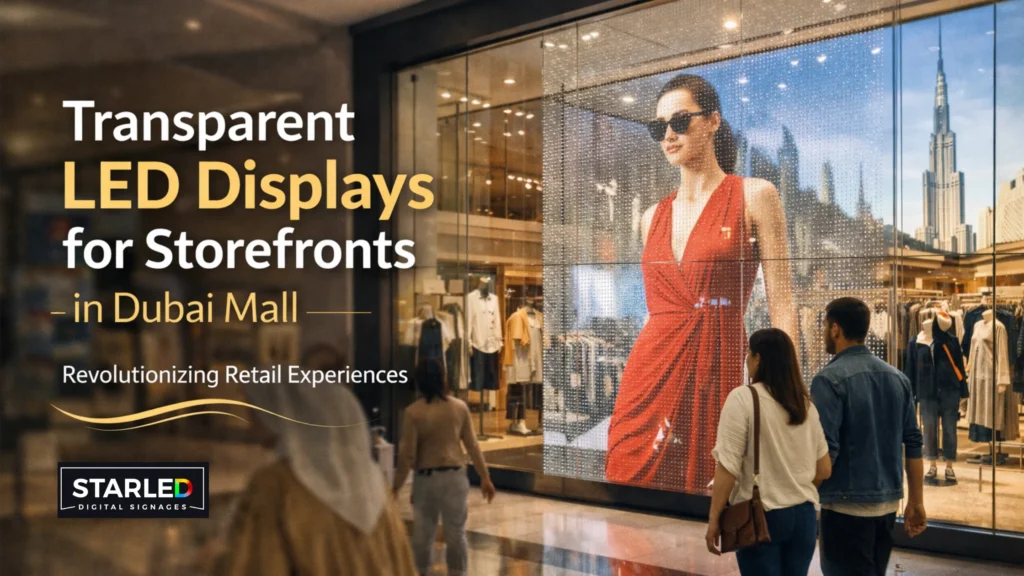
If you’re a Retail Director or Store Architect spec’ing a shopfront in The Dubai Mall, Mall of the Emirates, or any flagship GCC retail destination, this guide is written for you.
Not the person browsing the idea. The person who needs to make a procurement decision, sign off on a structural loading schedule, or justify the CapEx to a CFO before Q3.
Transparent LED for luxury retail windows isn’t a novelty anymore. It’s a serious display technology that, when specified correctly, can drive measurable dwell time, elevate brand perception, and turn a glass shopfront into your highest-performing marketing channel. When specified incorrectly, it’s an expensive disappointment that looks washed out under atrium lighting and creates friction with your mall’s fit-out committee.
Here’s everything you need to know before you commit.
A transparent LED display works on a glass storefront in a Dubai mall by mounting a lightweight mesh or film-based LED panel directly onto the glass surface. The panel is composed of thin LED strips or modules with large open gaps between them; these gaps are what create the “transparency.” The glass behind the display remains visible through the screen structure. Content appears as vivid, illuminated pixels floating on the glass, while natural light and the interior store view pass through the open areas of the panel. The system connects to a content management unit concealed within the shopfront structure, requires no special glass treatment, and draws power from a standard electrical supply behind the fascia.
What Is a Transparent LED? How It Works on Glass
Transparent LED is a category of display technology purpose-built for glass surfaces. The core principle is straightforward: instead of a solid backlit panel, the display is constructed from a series of slim LED strips or mesh modules separated by intentional open space. Those openings are what give you transparency.
The technical structure looks like this:
- LED strips or bars, typically 8mm–12mm wide, are mounted in a parallel grid pattern
- Each strip contains the LED pixels and their driving circuitry
- The gap between strips (the “pitch” in the vertical axis) creates the visible-through portion
- The entire assembly is bonded or mechanically fixed to the glass surface, either front or rear
- A receiving card and control box, usually no larger than a laptop, sits behind the fascia and manages content delivery
What the shopper on the mall concourse sees: vivid, high-brightness content appearing to float on or within the glass. What they also see through the display: your store interior, your merchandise, your brand environment.
That dual-visibility is the commercial point. You’re not blocking your window. You’re adding a layer of dynamic storytelling on top of it.
Front-mount vs. rear-mount installation is the first architectural decision you’ll make. Front-mount (attaching the panel to the external face of the glass) typically gives you better viewing angles but requires approval from the mall’s retail fit-out guidelines. Rear-mount (inside the glass) is more common for luxury tenants in regulated environments like The Dubai Mall’s Fashion Avenue, where external façade changes are tightly controlled.
For a broader overview of how transparent LED compares against conventional digital signage for shopfronts, read our guide to transparent LED displays, covering the technology, use cases, and the key questions to ask your supplier before specification.
Transparency % Explained: 50%, 70%, 85% – What’s Right for You?
This is the specification that most buyers get wrong, usually because they default to the highest transparency number without understanding what they’re trading away.
Transparency percentage in LED panels describes the ratio of open area to total panel area. A 70% transparent panel means 70% of its surface is empty space; the remaining 30% contains the LED strips and circuitry.
Here’s how the three main tiers perform in a retail context:
50% Transparency
- Higher pixel density, with smaller gaps between LED strips
- Lower pixel pitch typically achievable (P3.9–P7.8)
- Better content resolution and fill at close viewing distances
- Noticeably reduces natural light entry and interior view
- Best suited for non-window applications: interior partitions, display cases, stage backdrops
- For a primary shopfront window facing the mall concourse, 50% tends to feel heavy and partially opaque, particularly under the bright ambient lighting of a UAE mall
70% Transparency
- The practical sweet spot for most luxury retail shopfronts
- Maintains a clear view of the store interior and display merchandise
- Achievable pixel pitches: P5.9–P10.4 depending on strip design
- Content reads well at viewing distances of 3–8 metres
- Compatible with most mall fit-out specifications for glass frontages
- Recommended as the default specification for ground-floor and first-floor tenants in high-footfall atrium environments
85% Transparency
- Maximum see-through effect; the display almost disappears when switched off
- Very low pixel density; content relies on high-contrast imagery and animation
- Best for large-scale architectural integration: full-height atrium windows, building façades, exterior glass walls
- Content needs to be designed for the medium; fine text and high-detail graphics don’t translate well
- Appropriate for flagship stores where the brand’s identity depends on a minimal, architectural aesthetic. Think of a ground-floor luxury watch house in Mall of the Emirates where the store interior is the spectacle
The practical rule: If your primary content type is lifestyle video, product close-ups, or brand campaigns, specify 70%. If the installation is large-format, architectural, and content will be motion-graphic and abstract, 85% gives you the cleanest visual integration.
Brightness in Atrium Environments: The Dubai Mall Challenge
This is where most transparent LED specifications fail. And it’s entirely avoidable with the right nit specification.
The problem: Dubai’s premier malls are designed around natural light. The Dubai Mall’s Fashion Avenue and its central atrium feature extensive glazed roofing. Mall of the Emirates integrates skylights and multi-level atrium spaces. Ambient illuminance in these environments regularly measures between 10,000 and 30,000 lux during peak afternoon hours, especially in zones positioned directly under skylights.
For context: a standard indoor LED display is typically rated at 800–1,200 nits. At 800 nits, under 15,000 lux of ambient light, your display becomes effectively invisible during the hours your store needs it most: 2pm–6pm on a Friday, when foot traffic peaks.
The minimum threshold for a Dubai mall storefront: 3,500 nits.
The recommended specification for atrium-facing installations: 4,500–6,000 nits.
High-brightness transparent LED achieves this through higher-efficiency LEDs per strip and advanced driving circuitry that can sustain elevated luminance without generating excess heat. This matters in the UAE context because thermal management directly affects longevity. A display running at maximum nits in a climate-controlled but warm retail environment needs robust heat dissipation, whether through passive aluminum extrusion in the strip housing or active cooling for the control electronics.
Automatic brightness control (ABC) is non-negotiable for this environment. An ABC-enabled system uses ambient light sensors, typically mounted externally on the glass, to adjust the display’s output in real time. At 10pm in a quieter mall, the system drops to 1,500 nits. At 3pm under direct skylight illumination, it pushes to 5,500. This both protects longevity and ensures consistent visual impact across the trading day.
CBRE’s UAE Retail Market Report consistently identifies The Dubai Mall and Mall of the Emirates as the region’s highest-footfall destinations, with combined annual visitor counts exceeding 110 million. The window of 12pm–8pm on weekends represents a critical conversion window for luxury retail. A display that reads well at any point in that window is a commercial asset. One that washes out before 5pm is a missed opportunity every single day.
Custom Sizing for Non-Standard Shopfronts
Standard transparent LED modules are typically manufactured in fixed cabinet sizes, most commonly 1,000mm x 500mm or 1,000mm x 1,000mm. The moment you’re dealing with a luxury retail environment, standard sizing becomes inadequate.
In The Dubai Mall’s Fashion Avenue, shopfront dimensions rarely conform to modular grids. You’re dealing with:
- Arched or curved glass in heritage-influenced store designs
- Floor-to-ceiling heights of 5–7 metres with irregular proportions
- Multi-panel configurations wrapping around corner plinths or pillar elements
- Split windows divided by structural mullions at non-standard intervals
The solution is custom module fabrication, where the LED strip pitch, cabinet dimensions, and overall frame dimensions are engineered to fit your specific opening. This is not a premium option; it’s a baseline requirement for luxury retail.
What to specify with your supplier:
- Custom cabinet dimensions: modules should be cut and assembled to fit your exact opening with less than 5mm edge-to-edge gap at joins
- Seamless join design: the join between adjacent modules should not be visible in the display content; this requires precise pixel mapping and software calibration at installation
- Curved panel capability: for bowed or radiused glass, the LED strip framework can be pre-curved to a specified radius during manufacture, typically achievable down to an 800mm convex radius
- Height-specific mounting systems: tall installations (above 3m) require intermediate support points; the mounting system needs to be engineered to the specific glass type and fixing substrate
For stores where the entire shopfront is a display, a concept being increasingly explored by luxury fashion and automotive showrooms, this custom approach is the only way to achieve a seamless, architectural result.
Installation Requirements: Structural Loads & Fixings
Transparent LED is light. But “light” is relative when you’re attaching anything to a glass frontage inside a premium mall.
Typical structural load data:
- Transparent LED panels: 6–12 kg/m² depending on module design
- For a 4m x 2.5m installation (10m²), you’re looking at 60–120kg of distributed load
- Control equipment (receiving cards, power supplies): an additional 5–10kg, typically wall-mounted behind the fascia
Fixing methods:
| Method | Best For | Load Capacity |
| Aluminium frame bonded to glass with structural silicone | Standard float glass, front-mount | Up to 20 kg/m² |
| Mechanical suction/clamp system | High-load installations, rear-mount | Up to 40 kg/m² |
| Suspended frame from ceiling structure | Floor-to-ceiling or large-format installations | Load transferred to building structure |
| Adhesive film systems (for film-based LED) | Low-load, temporary, or brand-refresh applications | Up to 4 kg/m² |
Glass compatibility: Standard transparent LED attaches to float glass, laminated glass, and double-glazed units. No tempering, special coatings, or tinting is required. If the glass has a solar control coating (common in UAE installations), verify with the supplier that the bonding agent is compatible; certain silicone formulations can react with Low-E coatings over time.
Mall fit-out approval: Before specification is finalised, the installation method must be submitted to the mall’s retail fit-out team. The Dubai Mall and Mall of the Emirates both require detailed shop drawings, load calculations signed by a structural engineer, and material samples prior to approval. Build this into your project timeline. The approval process typically takes 4–8 weeks and is independent of your LED supplier’s lead time.
Power & Content Management for Transparent LED
Power Requirements
Transparent LED is not a high-power draw compared to equivalent-sized solid LED walls, but it still needs careful planning:
- Typical power consumption: 100–200W/m² at maximum brightness
- For a 10m² installation: 1,000–2,000W peak draw
- Recommend specifying a dedicated 32A circuit per 10m² of display, even if average consumption is lower
- Power supply units should be mounted in a ventilated, accessible cabinet behind the shopfront, not inside the LED frame itself, for maintenance access
Content Management Systems (CMS)
This is where the operational reality of running a transparent LED display day-to-day is determined.
The essentials your CMS must support:
- Scheduling by time and day: your Friday afternoon content should be different from your Tuesday morning content without manual intervention
- Remote content updates: content should be pushable via the cloud or local network without requiring physical access to the control unit
- Brightness override: in addition to automatic brightness control, operators need a manual override for special events or emergency content scenarios
- Multi-zone playback: for larger installations covering multiple display sections, the ability to run different content on different zones simultaneously
- Format compatibility: MP4, MOV, PNG, JPG as minimum; ideally also supporting HTML5 for dynamic content (live pricing, countdown timers, social feeds)
For luxury brands running campaign-aligned content, the CMS needs to integrate cleanly with existing digital asset management workflows. If your creative team is already working in a DAM system, your LED CMS should accept direct file imports, not require manual re-export and reformatting. For further reading on how smart content management is evolving across retail environments, see our piece on AI-integrated LED signage and programmatic content.
Cost Guide: Transparent LED Investment vs Standard Digital Signage
This section gives you benchmarks, not quotes. Actual pricing varies by specification, custom requirements, and installation complexity. Use these figures for CapEx planning and internal business case preparation.
Transparent LED: Indicative Cost Ranges (UAE, 2026)
| Installation Size | Specification | Indicative Range (AED) |
| Small storefront (up to 5m²) | 70% transparency, 4,500 nits, standard modular | 18,000 – 35,000 |
| Medium storefront (5–15m²) | 70% transparency, 4,500–6,000 nits, semi-custom | 35,000 – 85,000 |
| Large/full-window (15–30m²) | 85% transparency, custom sizing, high-brightness | 85,000 – 180,000 |
| Full architectural integration (30m²+) | Custom engineering, curved, multi-zone | 180,000+ |
Installation, content management system licensing, structural engineer sign-off, and mall fit-out submission fees are typically additional line items. Budget 15–25% of hardware cost for full project delivery.
How Does This Compare?
vs. High-brightness LCD window displays: For a single 75″ high-brightness LCD panel (~AED 15,000–25,000), you get a solid opaque display with no transparency. Transparent LED at equivalent display area costs more, but you retain store visibility and can cover significantly larger surface areas without creating a visual barrier.
vs. Standard indoor LED walls: A standard indoor fine-pitch LED wall for a comparable area (without transparency) will typically cost 30–50% less per m². The premium for transparent LED reflects the optical engineering, higher-efficiency LEDs, and the manufacturing precision required to achieve consistent pixel visibility through an open-grid structure.
ROI framing: In a high-footfall Dubai mall environment, shopfront displays that generate measurable dwell increases and footfall conversion are not difficult to justify. If a transparent LED window display contributes to even a 2–3% increase in walk-in conversion across a flagship store, the payback period on an AED 85,000 installation, relative to the average transaction values typical of luxury Dubai retail, is measured in months, not years.
For a direct comparison of transparent, standard LED, and high-brightness LCD across key retail metrics, read our dedicated breakdown: Transparent LED vs Standard LED vs High-Bright LCD for Shopfronts.
If you’re also evaluating digital signage options for your store’s interior, concierge desks, interior brand walls, and fitting room corridors, our indoor displays range covers fine-pitch, COB, and all-in-one solutions suited to luxury retail environments.
FAQ
How transparent is transparent LED?
Commercial products range from 50% to 85% transparency. For window displays, 70% or above is recommended to maintain brand visibility into the store and preserve the open, premium feel of a luxury shopfront. At 70%, a shopper standing on the mall concourse can clearly see both the display content and your store interior simultaneously.
Can transparent LED screens show vivid content in bright Dubai malls?
Yes, but only if you specify the right brightness. High-brightness models rated at 4,000 nits or above compensate for atrium daylight in venues like The Dubai Mall. Standard-brightness transparent LED (1,000–2,000 nits) will appear faded or invisible during peak afternoon hours in skylit mall environments. Always verify the sustained nit rating (not the peak rating) before purchasing.
Does transparent LED require special glass?
No. Transparent LED attaches to standard float glass and does not require tempering, tinting, or special lamination. For rear-mount installations on double-glazed units, confirm with your supplier that the mounting system is compatible with the unit’s spacer bar configuration. No structural modification to the glass is required in the vast majority of retail installations.
What is the minimum pixel pitch for a luxury retail window display?
For viewing distances of 3–5 metres (typical for a mall concourse), a pixel pitch of P5.9–P7.8 on a 70% transparent panel produces adequate content resolution for video and photography. For installations viewed from under 3 metres, particularly in low-footfall luxury corridors, P3.9 at reduced transparency (50–60%) gives sharper imagery.
How long does a transparent LED display last?
Quality LED modules carry a lifespan rating of 100,000 hours at 50% brightness. In a retail environment running 14 hours per day, that equates to approximately 19 years of operational life. The practical service period before brightness degradation becomes noticeable is typically 5–8 years. LED drivers and power supplies should be treated as consumable components with a 5-year replacement expectation.
Can the display be removed or replaced without damaging the glass?
For mechanically-fixed systems (clamp or frame-based), yes, the display can be removed without glass damage. For adhesive-bonded installations, removal requires careful application of heat and solvents, and in some cases residue treatment. If your brand refresh cycle is shorter than 5 years, specify a removable mounting system from the outset.
Who handles mall fit-out approval for transparent LED installations in Dubai?
The tenant or their appointed fit-out contractor is responsible for fit-out submissions to the mall operator (Emaar Malls for The Dubai Mall; Majid Al Futtaim for Mall of the Emirates). Submissions typically require shop drawings, material data sheets, load calculations, and fire classification certificates for the LED components. Your LED supplier should be able to provide all technical documentation required for the submission package.
Wrapping it up!
Ready to specify? Our team works directly with retail directors, fit-out architects, and mall operators across the UAE and GCC to engineer transparent LED installations that clear fit-out approval and perform under real atrium conditions. Contact StarLED Display to discuss your shopfront brief. View our completed retail and commercial LED projects across the UAE to see transparent LED and high-performance display solutions in real-world installations.