
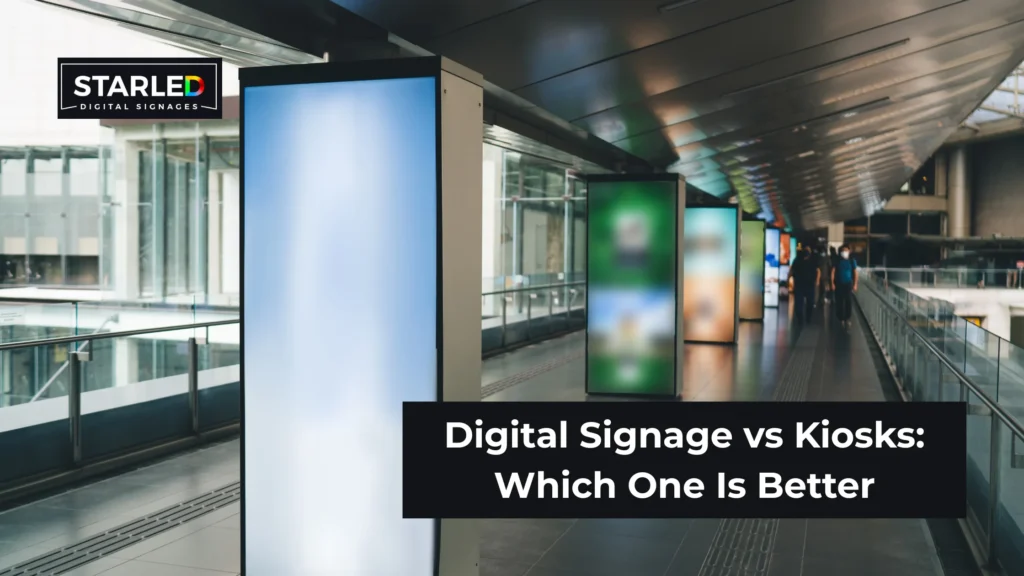
Walk into any mall, airport or government centre in the UAE and you will notice two very different kinds of screens.
One is mounted on walls, playing ads, offers and announcements all day. The other is a standalone unit with a touch screen display that lets you tap, type and get things done.
That is the real question behind digital signage vs kiosks. Do you need a screen that talks to everyone at once, or a screen that lets each person help themselves.
What is Digital Signage
Digital signage is any electronic display that shows multimedia content to a broad audience. It covers everything from:
- Wall mounted screens in shops and offices
- LED digital signage in malls and metro stations
- Giant LED billboards on building facades
These displays run videos, promos, announcements, menus, wayfinding and live data on a loop. The goal is one to many communication. One screen engages hundreds or thousands of people over the day without anyone touching it.
Modern digital signage often uses high brightness indoor LED displays in retail and corporate spaces and outdoor LED walls in public areas. That keeps content sharp and visible even in bright UAE lighting.
What is an Interactive Kiosk
An interactive kiosk is a self contained digital terminal that does more than just show content. It combines:
- A touch screen display
- Software for guided journeys
- Often extra hardware like printers, scanners or card readers
In day to day use, a kiosk behaves like a digital counter. It lets people check in, look up information, complete forms or make payments without a staff member.
You see smart kiosks across the UAE in:
- Fast food outlets for self ordering
- Government service centres for bill payments and document services
- Malls for wayfinding and store directories
- Airports and hotels for self check in
Kiosks are designed for one to one interaction. One person stands in front of the screen, goes through a personal flow and finishes a task. Many units offer English and Arabic so visitors, residents and tourists can all use the same self service kiosk comfortably.
The key difference from digital signage is simple. Digital signage talks. Kiosks listen and respond.
Key Differences Between Digital Signage and Kiosks
Both technologies use screens but they solve different problems. When you compare digital signage vs kiosks, these are the levers that matter.
Interactivity
Digital signage is passive. It plays content to inform, promote or guide people. Nobody can change what is on screen at that moment. It is designed to reach many people quickly.
Kiosks are interactive. The entire idea of an interactive kiosk or smart kiosk is that people tap, scroll and enter data. The system responds to each choice.
If you want customers to input details, pick options or finish a transaction, kiosks are the right fit.
If you want to broadcast messages, offers or information at scale, digital signage is the better tool.
Content and Purpose
Digital signage is built for broadcast content and branding. Typical roles include:
- Highlighting promotions and new arrivals
- Showing welcome messages and corporate content
- Running schedules, alerts or live information
- Creating ambience with visuals and motion
Kiosks are built for self service tasks. Common journeys include:
- Product lookups and service menus in a retail kiosk
- Order placement and customisation in quick service restaurants
- Wayfinding directions in large malls and campuses
- Ticketing, bill payment or document submission in government and transport hubs
In short, digital signage pulls people in and keeps them aware. Kiosks let people dive in and get things done.
Reach and Session Style
Digital signage reaches everyone who can see the screen. Hundreds of people can benefit from one screen in a high traffic area.
Kiosks work one person at a time. While fewer people use each kiosk per hour, every session is deeper and more personalised. That is why they sit side by side so often. One system handles awareness, the other handles action.
Benefits of Digital Signage
Across UAE sectors, digital signage has become a default layer of customer engagement technology for good reasons.
High impact visuals
Digital signs bring content to life in a way printed posters simply cannot. Video, motion graphics and sharp text on LED digital signage catch the eye in busy spaces.
In retail, a well placed indoor LED display at the shopfront can act like a moving shop window that keeps changing through the day. At events, large LED screens become the visual backbone of the stage, exactly as covered in StarLEDs blog on LED screens for events in Dubai.
Flexible and efficient messaging
Once the system is in place, content can be updated in minutes. You can:
- Swap creatives for new campaigns
- Run different content by time of day
- Localise messages by location
That flexibility reduces printing costs and eliminates the lag between marketing decisions and what people actually see in your space.
Consistent brand experience
Because all content flows through central templates and playlists, you can keep colours, fonts and tone consistent. Every screen becomes another brand touchpoint that looks on brand, whether it is in a store, a lobby or a public area.
Limitations of digital signage
Digital signage is still a one way outlet. It does not answer individual questions or process requests. It can point people in the right direction but it cannot complete the journey for them.
There is also a content responsibility. If the playlist is poorly designed or rarely updated, people stop noticing it. And if you plan outdoor screens you will need weather rated hardware with very high brightness to stand up to UAE sun, heat and dust. That is essential in key locations but not necessary for every site.
Benefits of Interactive Kiosks
Interactive kiosks tackle a different part of the customer journey. They shine wherever queues, forms and repetitive staff tasks are slowing you down.
Convenient self service
A good self service kiosk lets people complete simple actions without waiting at a counter. That can mean:
- Checking in for appointments
- Printing a ticket or token
- Placing an order and paying on the spot
Queues move faster, staff can focus on complex cases and customers feel more in control of their time.
Deeper engagement per person
Because a kiosk runs a full session for one user, it can provide more detail and guidance than a generic sign. A smart kiosk can:
- Adjust options based on earlier choices
- Offer multi step help instead of a single static FAQ
- Display personal information that would not be shown on shared screens
For journeys that require data entry, confirmation and review, kiosks are the safest and most efficient way to handle the flow.
Insight from usage data
Every tap and every completed session adds to a pool of data. Over time you can see:
- Which services are used most often
- Where people drop off in a journey
- How long different tasks really take
That makes it easier to refine both the interface and the underlying process.
Limitations of kiosks
Kiosks come with higher unit cost and more moving parts than a simple digital sign. You may need fewer units, placed very carefully in the right spots.
Hardware like touch screens and printers must be maintained. If a kiosk is offline, that self service point disappears until it is fixed.
User experience also matters. If the interface is confusing, slow or cluttered, people will avoid it. A kiosk project lives or dies on clear flows, good language and simple on screen guidance.
How UAE Industries Use Digital Signage and Kiosks Together
The most effective deployments in the UAE use both systems in a complementary way.
Retail and malls use digital signage for campaigns, branding and ambience, with LED screens at entrances and in store. At the same time, retail kiosks and wayfinding kiosks help shoppers find stores, check offers or navigate large complexes.
Hospitality and food service rely on digital signage for lobby information, live event boards and digital menus. Kiosks support self check in at hotels and self ordering at quick service counters where speed is critical.
Healthcare uses digital signage for queue information, directions and health messaging in waiting areas. Kiosks handle check in, token generation and bill payments so front desks are less overloaded.
Transport and public spaces depend on digital signage for live timetable information and alerts. Interactive kiosks sit nearby to sell or recharge tickets, manage bookings and handle travel card services.
Government centres and universities follow the same pattern. Digital signs guide and inform. Kiosks handle specific actions like form submissions, payments and registration. At large events, big LED screens create the visual experience, while kiosks at entry points manage registrations and feedback, something that has become standard in the region.
Choosing the Right Solution
There is no universal winner in the digital signage vs kiosks debate. Each tool fits a different job. The right starting point is a simple set of questions.
- Do you primarily need to show information to many people or help individuals complete tasks
- Are visitors mostly passing through and glancing around, or arriving with a specific job to do
- Do you need broad coverage across a site, or a few high impact self service points
If your priority is awareness, promotion and information at scale, digital signage is usually the better first investment. If your priority is reducing queues and automating routine interactions, interactive kiosks should be at the top of the list.
In many environments, the best answer is a mix of both. Digital signage pulls attention and sets context. Kiosks take over when someone is ready to act.
If you want to plan that mix for your own space in the UAE, you can contact us on StarLED Display, explore indoor LED displays and browse the StarLED blog for more use cases. That will give you a clear picture of how the right screens and systems can lift both customer experience and operational efficiency in a very real way.