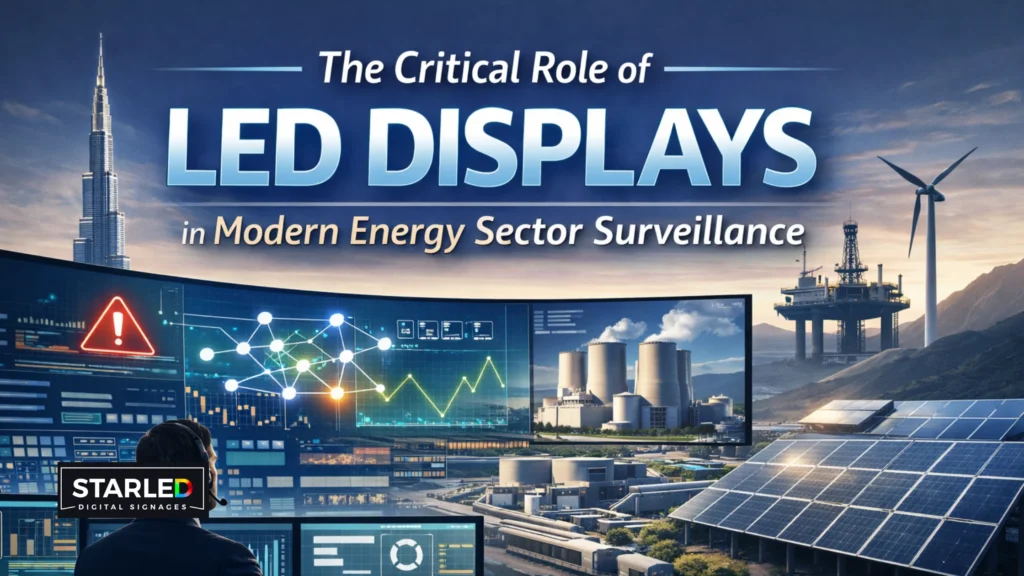
Imagine this: It’s mid-July in the UAE. Outside, the temperature has soared past 50°C, and a shamal is kicking up dust across the desert. Inside the central control room, the grid load is peaking as millions of air conditioners work overtime. You are staring at a massive video wall, monitoring thousands of data points from the Mohammed bin Rashid Al Maktoum Solar Park to the pipelines in Ruwais.
Suddenly, a sensor flickers red.
In that split second, clarity is everything. If your display is grainy, dim, or segmented by thick bezels, you might miss the anomaly that precedes a critical failure. But if you are using high-performance LED displays for the energy sector, you see the threat instantly sharp, bright, and undeniable.
The stakes? They couldn’t be higher. In the modern energy landscape, surveillance isn’t just about watching security cameras; it’s about visualizing the pulse of the nation’s infrastructure. Let’s break down why the UAE’s energy giants are moving away from traditional screens and why your facility needs to follow suit.
Why UAE’s Energy Sector Demands Advanced LED Displays
The United Arab Emirates is not just an energy producer; it is a global pioneer in energy diversification. With initiatives like the UAE Net Zero by 2050 strategic initiative and the massive expansion of the Barakah Nuclear Energy Plant, the complexity of our grid has exploded. We are no longer just monitoring oil flow, we are balancing nuclear baseloads with intermittent solar spikes and gas turbine outputs.
This hybrid grid requires what we call “total situational awareness.” Entities like DEWA (Dubai Electricity and Water Authority) and ADNOC (Abu Dhabi National Oil Company) operate strictly 24/7. There is no downtime. There is no “off” switch.
Here’s the challenge: The environment itself is hostile. While control rooms are air-conditioned, the sensors and remote surveillance displays in the UAE often face extreme heat, fine dust, and
humidity. The data feeding into your command center is relentless, SCADA streams, CCTV feeds, meteorological data, and cybersecurity logs all vying for attention on a single surface. Only the most robust display technology can handle this load without faltering.
Beyond Traditional Screens: Why LED Technology Wins
You might be asking: why not stick with LCD video walls or projectors? They’ve been around for decades.
The answer lies in the limitations of the old tech. Traditional LCD video walls are plagued by bezels, those black lines grid-locking your image. When you are monitoring a pipeline map or a complex electrical schematic, a bezel can literally cut a critical line of data in half. Projectors? They require constant bulb replacements and struggle with ambient light.
LED technology changes the game entirely.
Modern control room LED screens offer a seamless, bezel-free canvas. Whether your wall is 5 meters or 50 meters wide, the image is continuous. Furthermore, the brightness and contrast ratios of LED (Light Emitting Diode) technology are vastly superior. In a brightly lit crisis management room, an LED wall cuts through the glare, ensuring data is legible from every angle.
But the biggest win is reliability. With a lifespan often exceeding 100,000 hours and modular designs that allow for hot-swapping (replacing a module while the screen is still running), LED displays ensure that your eyes are never off the ball.
5 Critical Features Energy Operators Must Look For
If you are in the market for SCADA monitoring displays or general surveillance screens, you cannot simply buy off the shelf. The demands of the energy sector are unique. Here is your practical buying guide: what matters, and what is just marketing fluff.
Pixel Pitch: The Devil is in the Detail
For a control room where operators sit close to the screen, pixel pitch (the distance between LED clusters) is paramount. You need a fine pixel pitch, likely between 0.9mm to 1.5mm. This ensures that text, numbers, and fine schematics are razor-sharp, not blocky. If you are looking for top-tier indoor LED displays, aim for MicroLED or COB (Chip on Board) technology for forensic-level detail.
High Refresh Rate
You’re monitoring fast-moving data and security feeds. A standard screen with a low refresh rate causes motion blur and “ghosting.” For energy infrastructure monitoring, look for a refresh rate of at least 3840Hz. This ensures that live video feeds are buttery smooth, allowing operators to track movement without eye strain.
Redundancy systems
In the energy sector, failure is not an option. Your LED solution must have power and signal redundancy. This means if one power supply fails, a backup kicks in instantly without the screen flickering. Ask your LED screen supplier in Dubai specifically about “dual-path backup” capabilities.
IP Rating for Harsh Environments
If you are installing screens in semi-outdoor areas or dusty plant floors, the Ingress Protection (IP) rating is non-negotiable. An IP65 LED display protects against the fine desert dust and humidity common in the UAE. Don’t compromise here; dust intrusion is the silent killer of electronics in this region.
Low Blue Light & Heat Dissipation
Operators stare at these screens for 12-hour shifts. High blue light emissions cause fatigue. Look for “Common Cathode” technology, it runs cooler (saving on AC costs) and offers better color accuracy with less eye strain.
Real-World Applications in UAE Energy Infrastructure
Where exactly do these displays fit into the puzzle? Let’s look at specific use cases across the emirates.
- The Integrated Control Center (ICC): This is the brain of the operation. Here, massive curved LED walls visualize the entire grid. Operators overlay weather data on top of solar production charts to predict output drops during sandstorms. The seamless nature of the screen allows for dynamic resizing of windows, pulling up a CCTV feed of a substation in Al Ain instantly when an alarm triggers.
- Perimeter Security for Critical Assets: Oil refineries and nuclear plants require military-grade security. Surveillance displays in the UAE connect to thermal cameras and motion sensors along the perimeter fence. High-contrast LED screens allow security teams to distinguish between a stray gazelle and a potential intruder, even in pitch-black conditions.
- Emergency Response & Crisis Rooms: When a crisis hits, be it a cyberattack or a pipeline leak executives need a “single pane of glass” view. Office LED screens in Dubai boardrooms often double as crisis command centers, pulling real-time data from the operational technology (OT) network to facilitate rapid decision-making.
- Field Monitoring Stations: For remote wellheads or solar parks, ruggedized outdoor LED displays provide on-site engineers with critical status updates without needing to return to the central office. These screens must be readable under the blazing Gulf sun, requiring brightness levels of 6,000 nits or more.
The Human Factor: Supporting Better Decision-Making
We often talk about specs: nits, hertz, and pixels. But what about the people?
Cognitive overload is a real threat in modern energy operations. An operator acts as the final firewall between normal operations and catastrophe. If their screen is flickering, or if the colors are washed out, their brain has to work harder to process the information. This leads to fatigue.
High-quality 24/7 monitoring screens are ergonomic tools. They present data with high dynamic range (HDR), making red alarms pop against black backgrounds. They maintain uniform brightness over years of use, so one part of the wall doesn’t look dimmer than the other. By investing in premium display technology, you aren’t just buying a screen; you are investing in the alertness and accuracy of your human workforce.
Can your current setup say the same?
Frequently Asked Questions
What is the best pixel pitch for a control room LED display?
For control rooms where operators are seated 2-3 meters away, a pixel pitch of 0.9mm to 1.2mm is ideal. This creates a “Retina” effect where individual pixels are indistinguishable, reducing eye strain and allowing for the display of detailed text and schematics.
Why are LED displays better than LCD video walls for SCADA?
LED displays are seamless, meaning no bezels break up the image. This is critical for SCADA monitoring where lines and maps span across screens. Additionally, LEDs offer longer lifespans (100,000+ hours) and better brightness control compared to LCDs.
Can LED displays withstand the UAE’s heat and dust?
Yes, but you must choose the right model. Look for screens with robust heat dissipation designs (like Common Cathode technology) and high IP ratings (IP65 front and rear) to prevent dust ingress and overheating in non-climate-controlled environments.
How do LED displays improve energy sector cybersecurity?
While the display itself is hardware, its ability to visualize complex network traffic in real-time allows cybersecurity teams to spot anomalies faster. Large-scale visualization walls enable the “fusion” of physical security (CCTV) and digital security (firewall logs) on a single canvas.
What is the maintenance requirement for a 24/7 surveillance wall?
Modern LED walls are designed for low maintenance. Top-tier systems allow for front-access maintenance, meaning a technician can swap out a faulty module in seconds using a magnetic tool without shutting down the entire wall (hot-swapping).
Is Your Control Room Ready for the Future?
The energy sector is evolving faster than ever. Don’t let outdated display technology be the bottleneck in your operations. Whether you need a massive command center video wall or ruggedized outdoor monitoring, you need a partner who understands the unique challenges of the UAE climate.
At Star LED Display, we specialize in mission-critical visual solutions. Explore our range of indoor LED displays for control rooms or check out our robust outdoor LED displays for field operations.
Ready to upgrade your vision? Contact the leading LED screen supplier in Dubai today and let’s build a surveillance solution that never blinks.