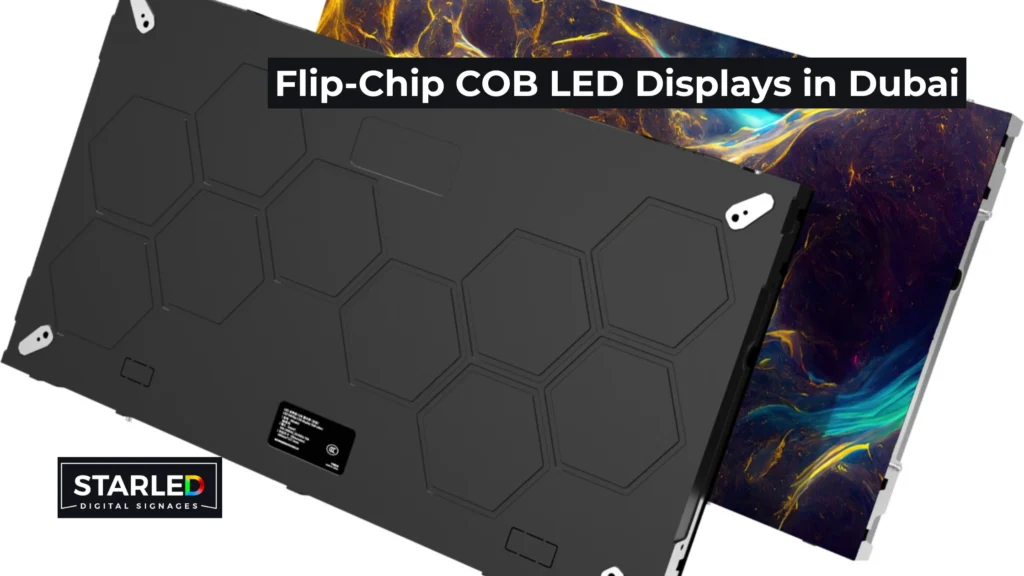
A flip-chip COB LED display is a premium indoor LED technology built for close viewing, cleaner visuals, better heat handling, and fewer fragile packaging points. It’s the right call for boardrooms, control rooms, studios, luxury retail, museums, and high-footfall lobbies where people stand close and uptime matters.
If you’re building in the UAE, the real win is simple: a wall that looks premium on Day 1 and stays stable on Day 500.
NX Series at a Glance
The NX Series Indoor LED Display is a fine-pitch, native 16:9 COB wall built for close-up clarity in boardrooms, retail, and control environments in the UAE.
- Choose 0.9375 mm when viewers are very close
- Choose 1.25 mm when viewing is mixed
- Expect 600–1000 nits, 10,000:1+ contrast, and 3840 Hz refresh for clean motion and camera-friendly performance
Best for
- Boardrooms and executive meeting rooms
- Retail feature walls and glassy lobbies
- Museums, studios, and high-visibility indoor zones
Next step: Start with viewing distance, then shortlist pitch. For a broader comparison, browse Indoor LED Displays:
https://starleddisplay.com/indoor-displays/
First, What Flip-Chip COB Actually Means
Let’s break it down without tech noise.
COB
COB (Chip-on-Board) mounts multiple LED chips directly on the board and seals them under a protective layer. The result is a smooth pixel surface that’s more forgiving in real-world use.
Flip-chip
Flip-chip flips the LED die and bonds it directly, so the design removes wire bonds. That matters because wire bonds can be a stress point over time.
Flip-chip COB
Put together, flip-chip COB is often chosen in fine pitch indoor walls where small visual issues become obvious fast.
Now, here’s the important part.
This is not about buying “the most advanced tech”.
It’s about buying the right outcome.
Why This Matters More in Dubai Than Most Buyers Expect
Dubai “indoor” installs are not gentle environments. They’re polished, high-pressure, always-on environments.
1) Close viewing exposes every weakness
When your closest viewer is 1 to 5 meters away, you cannot hide pixel structure, uneven blacks, or messy gradients. Flip-chip COB is built for that near-field reality.
2) Cameras punish the wrong spec decisions
Boardrooms are now studios. Town halls are now content. If the wall is camera-facing, refresh and processing choices matter more than most vendors will admit.
3) Tight access is normal in UAE fit-outs
A lot of premium interiors leave limited rear space. That’s why front service is not a feature. It is risk control.
4) High-touch environments need tougher surfaces
Retail, institutions, lobbies, and galleries are high footfall. A wall that stays clean, stable, and easy to maintain is what protects your investment.
Traditional COB vs Flip-Chip COB: The Practical Difference
Traditional COB uses wire bonding.
Flip-chip COB removes it.
That one change has a ripple effect:
- Fewer fragile points
- Stronger thermal behavior
- Better consistency potential in fine pitch builds
Bottom line: Flip-chip COB is typically the better fit when you want
- Premium finish at close distance
- Clean gradients and stable blacks
- Reliability under long run hours
- A wall that still looks sharp after months of use
The 5 Decision Specs That Actually Control Quality
Most buyers get trapped in spec sheets. This is the clean shortlist that decides outcomes.
1) Pixel pitch (choose based on closest viewing distance)
Pitch selection is not about room size. It’s about your closest viewer.
- Very close viewing: P0.7 to P0.9
- Close viewing: P0.9 to P1.25
- Mid-close viewing: P1.25 to P1.56
Here’s the move: measure the closest viewing point and shortlist around it. Don’t guess.
2) Refresh rate and camera performance
If your wall will be on video calls or filmed, refresh matters. Many premium indoor systems run 3840 Hz and above depending on configuration.
3) Calibration discipline
A wall can have premium hardware and still look average if calibration is sloppy. Smooth gradients, skin tones, and uniform blacks come from tight tuning and consistent setup.
4) Contrast and black consistency
This is where premium indoor walls win or lose. A great indoor wall looks deep, clean, and controlled, not washed out.
5) Serviceability and redundancy
Front service matters. But uptime planning matters more.
Ask for:
- Practical front access plan
- Spare strategy
- Redundancy options where required
- A real service process, not a promise
Why This Technology Fits Dubai and UAE Indoor Installs
Now let’s connect the tech to the local reality.
1) Indoor doesn’t mean “low stress”
In real UAE projects, indoor LED walls often run long hours in bright interiors and enclosed cavities. Better thermal efficiency helps keep performance stable and reduces heat-related drift over time.
2) Close viewing exposes everything
Boardrooms and premium retail have viewers at 1–5 meters, so pixel structure, black consistency, and text sharpness become non-negotiable. Fine-pitch flip-chip COB ranges (like P0.7–P1.56) are built for this reality.
3) Cameras are part of the job now
Town halls, hybrid meetings, studio work, and content creation need high refresh + strong grayscale to reduce scan lines, flicker, and ugly banding on camera.
4) UAE interiors are high-touch environments
If the screen is near people (retail zones, lobbies, institutions), a sealed pixel surface and practical protection can make a big difference in day-to-day durability and cleaning cycles.
5) Maintenance access is often constrained
Dubai fit-outs regularly leave tight wall depth and limited rear clearance. A front-service cabinet design is not a nice-to-have, it’s risk control.
Dubai-Ready Use Cases Where Flip-Chip COB Makes Sense
If your project sits in any of these buckets, flip-chip COB is usually worth serious consideration.
Corporate
- Boardrooms
- Experience centres
- Townhall auditoriums
- Hybrid meeting rooms
Control and monitoring
- NOC and command centres
- Transport monitoring rooms
- Security rooms
Retail and premium interiors
- Shopfront and indoor feature walls
- Luxury showrooms
- Product launch zones
- Lobby statement screens
Media and content
- Broadcast sets
- Studio walls
- Camera-facing backdrops
NX vs COB PRO: Which One Should You Pick?
At this point, most buyers are deciding between two premium routes.
Pick NX when
- You want fine pitch clarity in a clean 16:9 build
- Your room needs sharp text, smooth video, and a sleek install
- You want a premium wall without going into ultra-fine pitch territory
Pick COB PRO when
- You need ultra-fine pitch options down to P0.7
- You want stronger protection features like IP54 surface sealing
- You’re building for high-footfall zones, studios, or strict uptime expectations
Read next:
https://starleddisplay.com/blog/cob-pro-indoor-led-display/
Where StarLED’s Indoor Flip-Chip COB Fits
NX Series (fine pitch, premium indoor clarity)
A strong fit for boardrooms and premium indoor walls where close viewing clarity and clean 16:9 build logic matters.
Read: https://starleddisplay.com/blog/nx-series-indoor-led-display/
COB PRO (ultra-fine pitch, premium applications)
Built for projects that demand tight pitch options, durability, and serious indoor performance across corporate, retail, education, and studio environments.
Read: https://starleddisplay.com/blog/cob-pro-indoor-led-display/
Want to explore all indoor options first?
Browse: https://starleddisplay.com/indoor-displays/
Or start from the main site: https://starleddisplay.com/
The Most Common Mistakes in Dubai Indoor LED Projects
These are expensive, and they’re avoidable.
Mistake 1: Choosing pitch based on budget alone
Budget matters. But if the pitch is wrong for your closest viewing point, you will pay for it every day with softer text and a less premium feel.
Mistake 2: Ignoring the camera use case
If leadership meetings are recorded, or the wall is behind speakers, you need to spec for camera performance from Day 1.
Mistake 3: Treating installation like a formality
A premium LED wall can look average with a weak structure, messy cable planning, or incorrect alignment.
Mistake 4: Not defining what’s included
A “screen-only” quote is not comparable to an end-to-end quote.
A proper quote should clearly list:
- Screen configuration
- Controller and processing
- Structure and installation
- Power and cabling approach
- Calibration and commissioning
- Training and content control support
- Service plan and spares plan
Want to see what this looks like in real installations? Explore recent work here:
https://starleddisplay.com/projects/
FAQs
Is flip-chip COB always better than SMD?
Not always. It’s often the better fit for premium close-viewing indoor projects. But the “best” choice depends on viewing distance, camera usage, and budget.
What pixel pitch is best for a Dubai boardroom?
Start with the closest viewing point. Many boardrooms shortlist around P0.9 to P1.25, and go finer when viewers are very close and detail is critical.
Can flip-chip COB be installed behind glass?
Yes, but plan for reflections and tuning. Always validate by demo using your actual content.
What should be included in a UAE indoor LED proposal?
Screen plus controller, structure, installation, calibration, commissioning, content control requirements, and service response plan.
Final Takeaway
Flip-chip COB is not a trend spec. It’s a premium engineering choice that protects visual quality and stability when the viewing distance is close and expectations are high.
If you’re planning an indoor wall in Dubai, the smartest next step is to shortlist the pitch range, confirm camera needs, and validate with a real demo workflow.