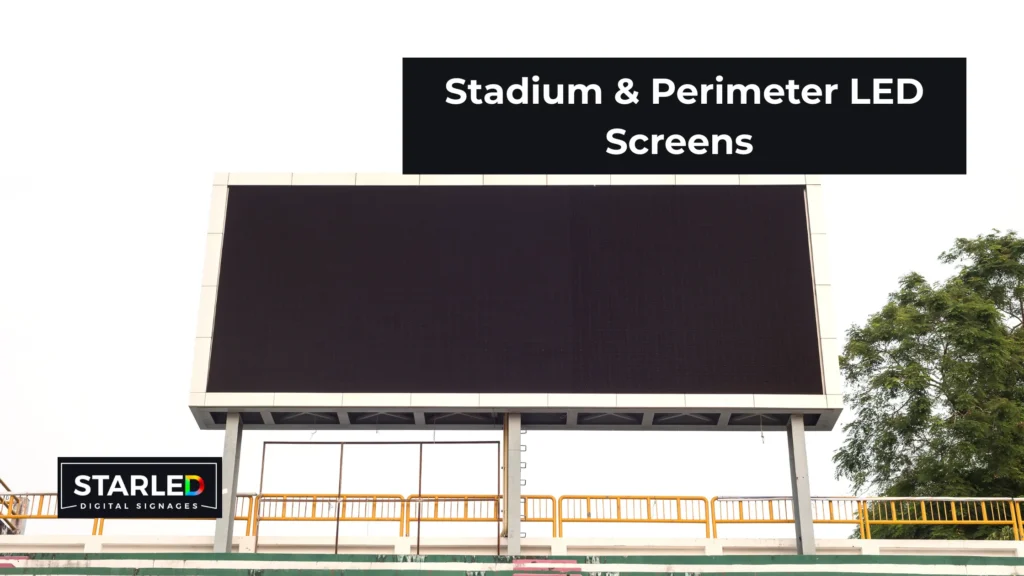
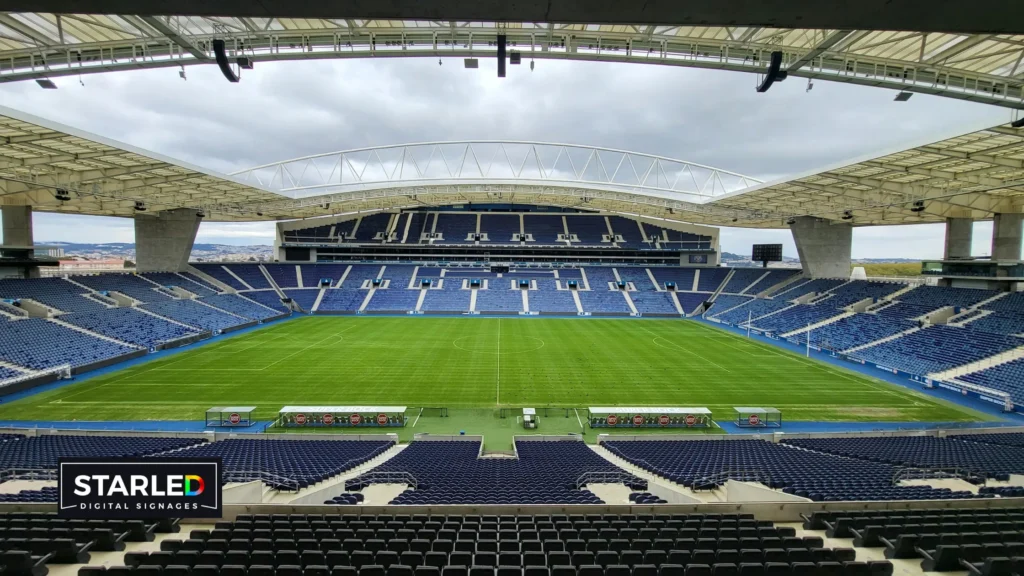
Perimeter LED advertising boards wrapping a pitch. A giant replay wall showing the winning moment in crisp detail. A scoreboard that stays readable in harsh daylight and still looks clean on broadcast cameras.
That is the new baseline for modern venues in the UAE.
If you are a stadium owner, sports venue operator, school administrator, or event manager in Dubai (and the wider GCC), this guide walks you through what actually matters before you buy: specs, zones, installation planning, UAE climate realities, mistakes to avoid, and what to expect from a reliable LED screen supplier.
Stadium LED screens are large outdoor displays used for replays, scoring, live feeds, and match-day messaging. Perimeter LED boards are pitch-side advertising displays designed for wide viewing angles, impact safety, and fast sponsor switching. In the UAE, the right result depends on camera-safe refresh performance, daylight visibility, IP-rated weather protection, and a service plan that keeps the venue running during live events.
What stadium and perimeter LED displays are (and what they are not)
What they are
- Stadium LED screens: Large-format outdoor LED video displays used for replays, scoring, live feeds, and crowd engagement.
- Perimeter LED boards: Long, low LED advertising boards placed around the field to run sponsor messages and announcements without blocking sightlines.
What they are not
They are not generic outdoor signage panels. Stadium environments demand:
- Broadcast-safe refresh performance
- Rugged, impact-tolerant cabinets
- Weatherproofing built for heat, dust, and humidity
- A service plan that works during live events
Key stadium LED screen zones (scoreboards, replay walls, perimeter LED boards)
Stadiums typically use multiple LED zones, each with a specific job. The mistake is buying “one type of screen” for everything.
| Zone | Primary purpose | What the screen must do well |
| Main scoreboard / replay wall (Jumbotron) | Score, clock, replays, stats | Long-distance clarity, high brightness, stable processing |
| Perimeter advertising boards | Sponsor ads, real-time messaging | Wide viewing angle, impact safety, fast content switching |
| Center-hung screens (arenas) | Scores + replays for all sides | Visibility from every seat, consistent color |
| End-zone / corner auxiliary screens | Fill blind spots, add scale | Coverage, reliability, readable graphics |
| Ribbon / fascia displays | Stats, tickers, sponsor loops | Uniformity, continuous readability |
| Exterior marquee / entrance screens | Event promotion, wayfinding | Daylight visibility, durability, basic scheduling |
Buyer note: Perimeter boards often run different content logic than replay walls. Treat them as different systems, not just different sizes.
Critical specs for stadium LED screens in UAE (refresh, brightness, IP, durability)
You are buying performance under pressure: sunlight, long distances, fast movement, camera filming, and zero tolerance for downtime.
Stadium LED spec table (what to ask, and why it matters)
| Spec | What to ask for | Why it matters in UAE venues |
| Brightness + contrast | Daylight-readable brightness with auto-dimming | Harsh sun needs clarity; auto-dimming avoids glare at night |
| Refresh rate (camera-safe) | Broadcast-friendly refresh (often 3,840 Hz and above) | Prevents flicker, banding, and scan lines on cameras |
| Pixel pitch | Pitch selection based on nearest and farthest viewing distance | Too coarse = unreadable text; too fine = wasted budget |
| Viewing angle | Wide horizontal and vertical viewing angles | Fans watch from side angles, not straight-on |
| IP rating | Outdoor-rated sealing (commonly IP65 or better) | Dust, humidity, rain, cleaning cycles |
| Corrosion resistance | Coastal-grade finishes and fasteners where needed | Dubai and other coastal locations face salt-air corrosion |
| Heat handling | Rated operating range + thermal management | High ambient heat plus high brightness creates thermal stress |
| Impact safety | Soft masks, padded edges, shock-tolerant design (perimeter) | Player and ball impact is normal, safety is non-negotiable |
| Cabinet serviceability | Front or rear access plan, quick swap modules | Live venues need fast repairs without cranes |
| Power design | Load planning, surge protection, redundancy options | Stadium screens draw high load and must stay stable |
| Signal + control | Reliable long-distance transmission + stable processors | Long cable runs and complex content workflows are typical |
| Monitoring | Remote diagnostics and alerts | Reduces downtime and speeds troubleshooting |
Pixel pitch rule-of-thumb (quick planning aid)
Use this as a starting point, then validate on site.
| Typical viewing scenario | What you optimize for | Pitch approach |
| Fans are far, screen is huge | Visibility over fine detail | Moderate pitch, high brightness, strong contrast |
| Fans are closer, text must be crisp | Scoreboard readability | Finer pitch where needed |
| Perimeter boards viewed across the pitch | Sponsor clarity, motion | Pitch that stays clean at distance, high refresh |
Installation and site planning (where stadium LED projects win or fail)
A stadium LED system is not “buy and mount”. It’s an engineering and operations project. This is also where the supplier matters most.
How StarLED Display fits: We handle the planning and execution as one chain, so the screen spec, structure, power, control, and service plan don’t fight each other later. We deliver as a Dubai-based LED screen supplier with GCC execution capability, with an end-to-end install model and support.
1) Structural mounting and wind planning (design for safety first)
What to get right
- Confirm load-bearing capacity and mounting points before finalizing cabinet type.
- Plan the steel or aluminum sub-structure with the correct load distribution.
- Validate sightlines so the screen is visible from all key seating angles.
- Factor wind exposure for elevated mounts and open stadium environments.
How StarLED delivers
- Site visit and mounting feasibility checks before final sizing.
- Structure planning aligned to cabinet weight, wind exposure, and access strategy.
- One execution owner across structure + screen + commissioning, so there is no blame game later.
2) Maintenance access (plan this before you buy)
Ask one simple question: If something fails during an event, how fast can it be fixed?
| Access method | Best when | Watch-outs | StarLED approach |
| Front service | Rear access is limited | Needs correct cabinet design + tools | We recommend front-service options where access is constrained and plan module swap workflow |
| Rear service | You can build a rear platform or corridor | Needs safe space + planned pathways | We plan maintenance corridors / rear clearance during layout and structure finalization |
| Lift-based servicing | Outdoor high mounts | Lift scheduling and cost must be realistic | We align the service plan to the venue’s actual lift access, timing windows, and safety rules |
How StarLED delivers
- Access planning is included in the pre-install survey, not treated as an afterthought.
- Serviceability is built into the product recommendation and install layout.
3) Cable routing and management (clean wiring = stable uptime)
What to get right
- Plan power and data routes early.
- Protect outdoor runs using conduits, trays, and proper clamping.
- Label and document cabling for future troubleshooting.
- Consider redundancy for mission-critical screens.
How StarLED delivers
- We implement structured wiring plans with clear routing, proper protection, and documentation.
- We design the routing to support service access, not block it.
4) Control room and content workflow (match-day ready)
Your control room should support:
- Stable processors and switching
- Integration with cameras, scoring systems, and data feeds
- Simple operation under match-day pressure
For schools and smaller venues, the workflow must be simple enough for staff or trained students to run confidently.
How StarLED delivers
- Control stack planning as part of deployment, not just screen supply.
- Clean handover so venue teams can operate day-to-day without dependence.
5) Power supply and protection (no shortcuts)
What to get right
- Dedicated circuits where needed
- Correct breakers, grounding, and surge protection
- UPS or backup planning for critical screens
How StarLED delivers
- Power planning aligned to screen load and site realities.
- Protection-first approach to reduce failures from power instability.
6) Testing and calibration (do not skip)
Before launch:
- Uniformity calibration (color and brightness)
- Test patterns and full content rehearsal
- Camera test for flicker and moiré risk
How StarLED delivers
- Commissioning includes calibration and functional testing before sign-off.
- Camera scenario testing is considered for venues that will be filmed or broadcast.
Why this makes StarLED a reliable supplier for stadium LED projects
Reliability in stadium LED is not a “spec sheet promise”. It’s the outcome of good planning and execution:
- Correct engineering inputs before purchase
- Service access built into the layout
- Clean power and cabling
- Stable control workflow
- Testing and commissioning done properly
- Local support expectation set clearly
UAE and GCC reality check: heat, dust, glare, cleaning, corrosion, and approvals
Heat
- Screens must be built for sustained high-temperature operation.
- Smart thermal monitoring helps prevent failures and extends life.
Dust, sand, and cleaning
- Dust is constant, not seasonal.
- Plan cleaning schedules and safe cleaning access.
- Proper sealing protects internal electronics.
Coastal humidity and corrosion
- Choose finishes and fasteners that resist rust.
- This matters more if the venue is near the coast.
Glare and daylight visibility
- Brightness is one part.
- Contrast and anti-glare surfaces reduce washout.
- Placement and orientation can reduce direct sun impact.
Regulations and approvals
Depending on location and visibility, approvals may be triggered by:
- New structures and steel framing
- Safety and electrical compliance
- Exterior visibility and digital signage rules
- League or federation rules for perimeter advertising formats
Practical point: approval planning early prevents redesign and rework later.
Beyond sports: educational and interactive uses (schools, academies, training facilities)
Stadium-grade screens are not only for match days. Schools and educational venues use LED systems for:
High-impact school scoreboards
- multi-sport modes
- team branding and student highlights
- professional-grade visibility for events
Assemblies, graduations, and events
- large-format visibility for presentations and ceremonies
- better than projectors in bright environments
Training and coaching
- replay sessions during practice
- strategy visuals and performance review
Community engagement
- community screenings, event hosting, school spirit moments
- signage and announcements during campus events
This is where LED becomes a multi-purpose asset, not a one-use upgrade.
Common mistakes to avoid (and how to avoid them)
| Mistake | What it causes | What to do instead |
| Wrong pixel pitch | Pixelation or unnecessary overspend | Select pitch using actual viewing distances |
| Ignoring refresh rate | Flicker on broadcast and phones | Specify camera-safe refresh from day one |
| Poor serviceability | Long downtime, expensive maintenance | Plan access and spares before purchase |
| Skipping calibration | Patchy color, inconsistent brightness | Include calibration in commissioning |
| Choosing cheapest quote only | Early failures and weak support | Compare specs, warranty, and local response |
Choosing a stadium LED screen supplier in Dubai (what to expect)
A serious LED screen supplier should deliver a full chain, not just hardware.
What a good vendor process looks like
- Needs assessment + site survey
- Detailed proposal (models, pitch, brightness, controllers, drawings, timeline)
- Structural + installation execution
- Control room setup + training
- After-sales support (spares, warranty, response time, maintenance options)
- Proof of capability (real installs, references, documented performance)
Tip: Always ask where spares are stocked and how fast support can reach your venue.
Dubai-based, GCC-capable: how StarLED Display fits
StarLED Display is based in Dubai, UAE, delivering stadium and outdoor LED screen solutions with a GCC delivery capability. For venues that need reliable performance, the goal is simple: correct specs, clean installation planning, and support that actually shows up when needed.
See our recent installations – https://starleddisplay.com/projects/